Challengers preview screening provided by Universal Pictures
Challengers feels like both a breath of fresh air for sports movies and a film struggling to find air, mainly because it’s less about the act of winning and more about savouring the build up to a point, soaking in the tension, and when Luca Guadagnino is the director, pushing the boundaries of continuous edging that only free spirited, experimental youths seem to bring. Make no mistake, tennis is the lens through which we untangle Guadagnino’s webs and fascination with youths being unorthodox, but this is by no means a sports rags-to-riches story like King Richard (2021) or a light-hearted underdog tale like Next Goal Wins (2023).
It follows two up-and-coming tennis prodigies, childhood friends Art Donaldson (Mike Faist) and Patrick Zweig (Josh O’Connor), and an established youth pro, Tashi Duncan (Zendaya). Things get a little complicated for this trio who meet long before Art becomes a touring pro and Tashi, his coach and wife. In fact, Guadagnino’s film takes many turns, often dovetailing from one moment in time to another, with Marco Costa’s editing giving the film this back-and-forth rally like quality, sometimes a bit too excessively but enough to keep you on your toes.
We open in the present, where Art’s game isn’t as great as it once was and Tashi signs him up for a challenger event in New Rochelle to find some flair before the US Open. Unbeknownst to Art, Patrick, now his former friend, will also be competing. It’s from here that Guadagnino cuts between the present and the past, sometimes for a matter of days, other times for years. It becomes clear that there’s some unresolved history between the trio who first met 12 years ago at a juniors tournament where they hit it off both on and off the court.
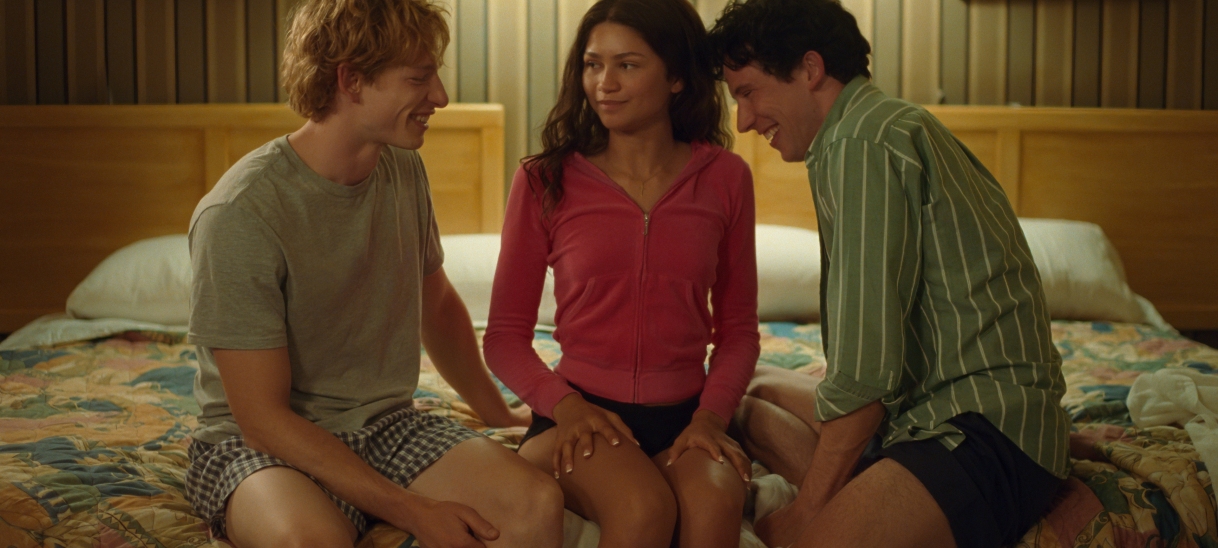
Guadagnino, an expert at extrapolating meaning from odd situations, uses Tashi as a catalyst for carnage, or to put it in her own words, a “homewrecker”. From early stages, her motivations aren’t entirely clear in terms of her fascination with the duo —there’s a steamy scene where the trio lock lips before Tashi pulls back and leaves Art and Patrick still going at it before she admires her work and ducks out— but she’s clearly the focal point that pushes the narrative forward. And that’s largerly because Zendaya does a great job at conveying this larger than life presence, mainly since that’s how she’s perceived in pop culture more broadly. Guadagnino is able to tap into that to a greater degree, working with cinematographer Sayombhu Mukdeeprom to box her into the frame through tight close-ups and really portray her as a figure of authority who has a grip on Art and Patrick that can’t be shaken off.
The enjoyment of the film comes from the tension that is bubbling beneath the surface, after all this is a story about competing and winning no matter the cost. That’s at least the mentality that Tashi has instilled into both Art and Patrick who, no matter their rankings in the wider sense, constantly seem to be tussling with one another. At the same time, this tussle seems to be less about proving anything to themselves and more about proving something to Tashi.
Ultimately, tennis provides the perfect platform for Guadagnino to pivot such ideas against one another, with the underlying horniness of it all working to give the film a unique edge —especially when paired with Trent Reznor and Atticus Ross’ pulsating techno score which further breathes life in any given moment. Whether or not this is the sort of film you’ll walk away from and continue to ponder isn’t clear, especially with an ending that doesn’t exactly prod you to ask any more questions but almost leaves you wanting more answers in the same unfulfilled way the trio have been all movie.
Challengers opens nationally from the 18th of April, 2024.
Dune: Part Two preview screening provided by Universal Pictures
Few working directors have the capacity to deliver such audacious tentpole features like George Lucas and Sir Peter Jackson, and even fewer are able to do so authentically while ensuring that the end result is nothing short of spectacular. But that’s exactly what Denis Villeneuve has done with Dune: Part Two, his sequel to 2021’s Oscar winning Dune: Part One.
To call Dune: Part Two anything other than a generation defining Sci-Fi would be to undersell just how monumental an achievement the director has on his hands. Where Part One focused more on methodical world-building and planting the narrative seeds of Frank Herbert’s iconic novel (some might say in a much more trimmed down, thin fashion than expected), Part Two is all about scale and upping the ante.
And it picks up almost immediately after the first film, where Paul Atreides (Timothee Chalamet) has found his way to the Fremen and is working towards building their trust, learning to assimilate in their ways, and realising his potential as a Messiah. There is seemingly more pandering this time around, with the first film having the skeleton of what is sure to become a trilogy, established, but lacking that extra flesh for why we should care about these characters, the Kwisatz Haderach or any of the novel’s deeper lore.
The care for those aspects all starts with Paul though, with his plight becoming increasingly refined by screenwriters Villeneuve and Jon Spaihts, who inject more oomph into the script. Paul is much more nuanced here, having had to grow up faster than he would have liked, especially now that the Harkonnens have reoccupied Arrakis (or Dune) and are actively pursuing spice. In turn, time is of the essence for Paul and the Fremen, especially as the Harkonnens edge closer to their hidden locations.
(L-R JOSH BROLIN as Gurney Halleck and JAVIER BARDEM as Stilgar in Warner Bros. Pictures and Legendary Pictures’ action adventure “DUNE: PART TWO,” a Warner Bros. Pictures release. (PRESS KIT)
As a result the film places greater attention on the interplay between Paul and the Fremen. Fremen leader Stilgar (Javier Bardem) has become the guiding voice of reason who echoes the idea that the chosen one has arrived. He puts Paul through his paces via a series of trials that test out whether he truly lives up to all that was foretold. Whether that’s venturing out into the desert to overcome its harshness, battling the Harkonnens as they attempt to harvest spice, or riding a Shai-Hulud without guidance —there’s not shortage of incredible individual moments that both propel the narrative forward but also leave one in awe every time.
It’s in these moments that Part Two really shines and speaks to Villeneuve’s eye for detail and scale. It helps that the returning Greig Fraser (who won an Oscar for his cinematography for the first film) once again captures Dune’s deceptively beautiful vistas on a macro level, which allows that scale to shine through. Everything on Dune looks blown up in size which works to its advantage in creating this look of endlessness and enormity, a creative decision that speaks to the gravitas of the journey awaiting Paul. It’s all the more crystallised in the vibrancy of the desert colours, which further evoke that deceptive beauty of a world that will show you no mercy and swallow you whole.
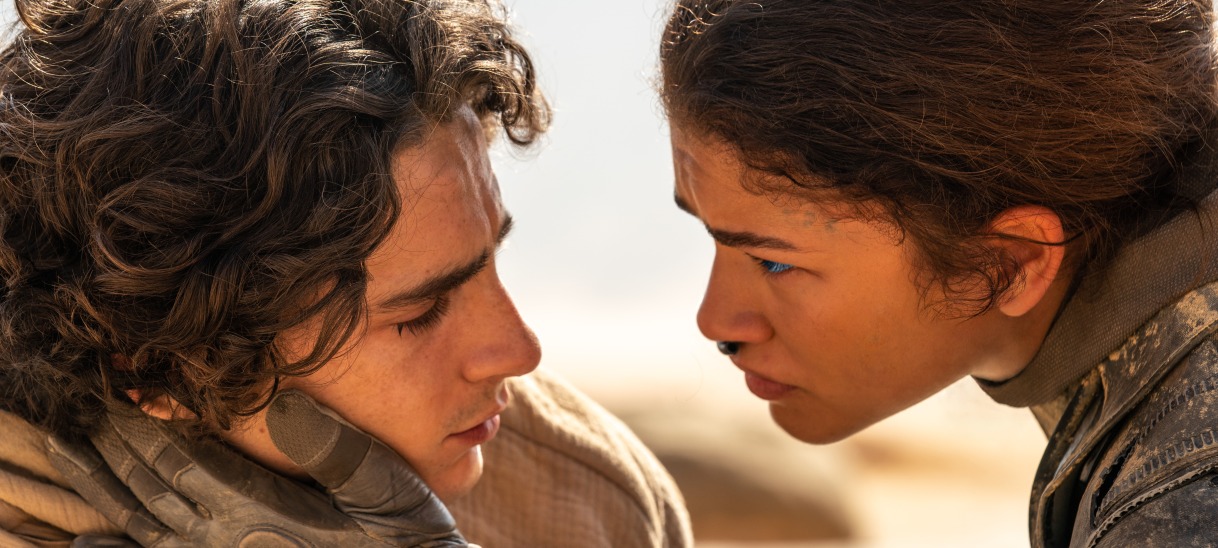
For Paul, the only beauty that isn’t deceptive is that of young Fremen warrior, Chani (Zendaya). She helps him through his series of trials while continuing to hold her own as a character of interest that isn’t just sidelined to play second fiddle as a muse. Often she claps back against the popular opinion of Stilgar, and refuses to fall privy to what she sees as a cause that doesn’t exactly serve the interests of her people.
In fact, most of the female characters in Part Two play crucial roles in the film’s events, with Paul’s mother Jessica (Rebecca Ferguson) embracing her destiny as the Fremen’s Reverend Mother. Princess Irulan (Florence Pugh) has a much smaller part in proceedings as the Emperor’s (Christopher Walken) daughter, serving more as a springboard for the plot and entry point to its politics rather than anything else, which isn’t a problem per se.
A scene from Warner Bros. Pictures and Legendary Pictures’ action adventure “DUNE: PART TWO,” a Warner Bros. Pictures release.
On the flip side are the Harkonnens, with the Baron (Stellan Skarsgård) returning in his hauntingly enlarged state alongside his incompetent nephew Rabban (Dave Bautista) who is continually being outsmarted by the Fremen as he tries to gather spice on Arrakis. But it’s Austin Butler’s portrayal as the Baron’s nephew, Feyd-Rautha, that is a particular standout; he comes across across as both raw and subtle, at once menacingly distant yet eerily close.
When the Fremen do lock horns with the Harkonnens, the result is always jaw-dropping set pieces with well choreographed fights that are supported rather than supplanted by those unique visual effects. The battles are also much easier on the eye compared to a majority of recent blockbusters, in that the action is discernible rather than messy. To top it off, Hans Zimmer’s score is also complimentary rather than excessive, with his use of drums and sharp crescendos aptly suiting the various cultures and moments (I had literal goosebumps at moments as the soundscape reverberated through my seat and being).
If there was to be a shortcoming it would be that the closing sequence rounds off rather abruptly. At various points throughout the film I couldn’t help but wonder how Villeneuve would bring everything together as the finish line was becoming clearer and closer to the end. However, he had always said that this was a continuation rather than a direct sequel, and that aspect is felt, even though audiences might be left wondering by the end —with some threads left hanging.
That said, there are few directors who can create a spectacle at such a scale while leaving their own mark and remaining faithful to the source material. Dune: Part Two takes the best parts of the second half of Herbert’s novel —allegory and all— and serves them up in a digestible, refined and spectacular result that is reminiscent of some of the best sequels (or continuations) in cinema history.
Dune: Part Two opens nationally from the 29th of February.
Denis Villeneuve’s adaptation of Frank Herbert’s widely beloved novel of the same name, Dune (2021), is a remarkable feat in blockbuster filmmaking that reaffirms why Villeneuve is one of the best working directors today. Villeneuve’s adaptation honours Herbert’s writing by matching it with visual splendour and creating an on-screen world that feels lived-in — something that hasn’t been felt on the big screen since the director’s last film, Blade Runner 2049 (2017).
There’s a reason why Frank Herbert’s science fiction novel had always been deemed unfilmable in the same way as J.R.R Tolkien’s The Lord of the Rings. Like The Lord of the Rings, Dune is comprised of a level of detail that captures the minutia of the world it creates and the characters that occupy it; whether that be through numerous internal monologues, vivid imagery through carefully selected wording, or just the fact that the ‘hero’s journey’ isn’t approached in a way that would seek to validate the protagonist’s actions.
That protagonist is the Muad’Dib, Lisan al Gaib, Kwisatz Haderach, Messiah — Paul Atreides (Timothee Chalamet). Mentioning all of the ways in which Paul is referred to in the book and film is important because it highlights just how nuanced of a character he is. Paul is many things to many different groups and people, be it the Bene Gesserit who are a sisterhood conditioned in superhuman ways; the Fremen who are the desert people of the planet Arrakis; and to those that know him across the story like Chani (Zendaya), Lady Jessica (Rebecca Ferguson), and Duncan Idaho (Jason Momoa), to name a few.
When it comes to the plot, two houses (House Atreides and House Harkonnen) have been feuding with each other for ages. It isn’t until the Padishah Emperor requests that Duke Leto (Oscar Isaac) and the rest of House Atreides move to and oversee the desert planet of Arrakis (Dune), that tensions begin to further boil between the houses as deceit and betrayal ensues. On the planet is the galactic currency known as the spice (a melange like substance) that is the source for discontent, power, and wealth, and as mentioned in the novel, “he who controls the spice controls the universe”.
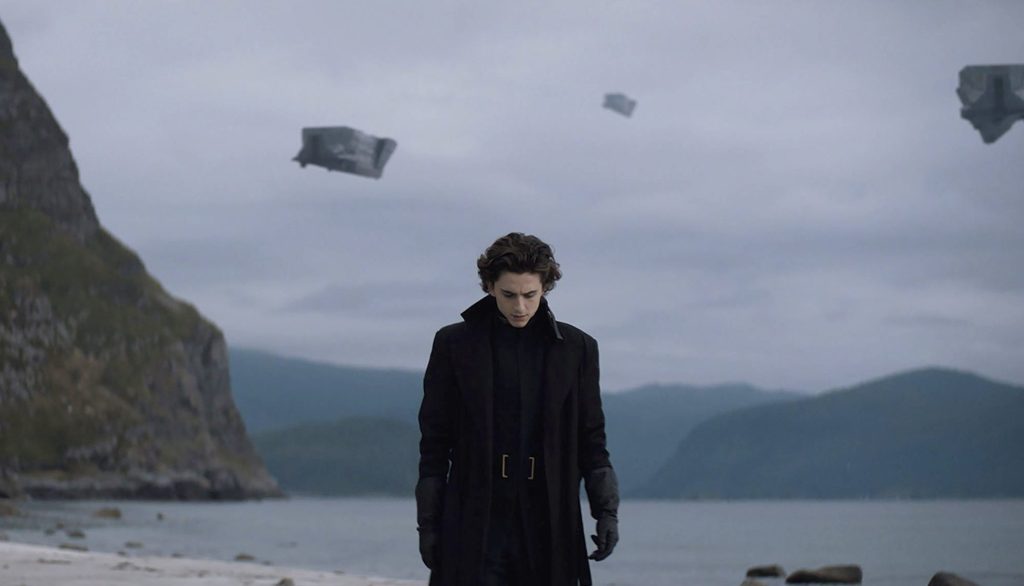
Timothee Chalamet in Dune
Alongside all of this is Paul who has a unique destiny that will change the lives of all of those around him. Paul is viewed as a messiah of sorts that has been bred and trained by the Bene Gesserit for the purpose of leading people into a better future, though at the expense of bringing about a potentially worse future known as the jihad (or ‘war’, as the film westernizes the term).
The story itself is a rather complex one, if not for Herbert’s aforementioned approach to writing the book, then for its emphasis on ideas pertaining to feudalism, mysticism, perennial truth, and a plethora of other nuanced ideas and leanings. Jon Spaihts, Eric Roth, and Villenueve do a good job of dissecting some of Herbert’s ideas for the screenplay, and adapting them for the screen through visual cues, motifs, and worldbuilding.
They take the heart of the story in Paul Atreides, and allow him to guide us through each given moment using visual storytelling and the affordances of the cinematic medium. In this way, for anyone that hasn’t picked up the novel, it’s relatively easy to follow the film and pick up on some of the concerns and ideas that penetrate Herbert’s telling through visual cues.
Villeneuve is a master of using visual storytelling to tell a complex story while leaving his own print on that story; It’s a large reason why Blade Runner 2049 worked so well and why Dune works just as well. The world he creates on-screen speaks for itself with its own visual language through setting, colour, visual effects, and cinematography. For instance, there is a scene involving the Sardaukar (the Padishah Emperor’s specially trained elite force) that captures the very essence of this force by using no dialogue. Rather, Villeneuve utilises framing, composition, visual effects and sound in a sequence that lasts barely a minute, but is able to depict the very ruthlessness of the Sardaukar in this short sequence. That’s just one of the many examples where Villeneuve shows and doesn’t tell — everything you need to know about this force is shown to you in this condensed form.
What Villeneuve isn’t able to do with Dune like with Blade Runner 2049, is give you a reason to care about the characters in this film. The first half of the film is paced incredibly quickly which is understandable given there is a lot of ground to cover in Herbert’s novel, however characters are what audiences latch onto for emotional support. The character of K (Ryan Gosling) in Blade Runner 2049 was multifaceted for an android, and the scale of the film never overwhelmed that connection built with him.
Some might view Villeneuve’s treatment of character as one that is reflective of Herbert’s own reluctance to provide overly accessible characters, however films need that connection otherwise you’re relying on visual bravado to take you where you need to go (which it does, but that aspect is a shortcoming nonetheless). I’d make the case that Herbert’s own novel offers characters like Gurney Halleck, Duke Leto, and even Paul to an extent, for emotional support and for connection.
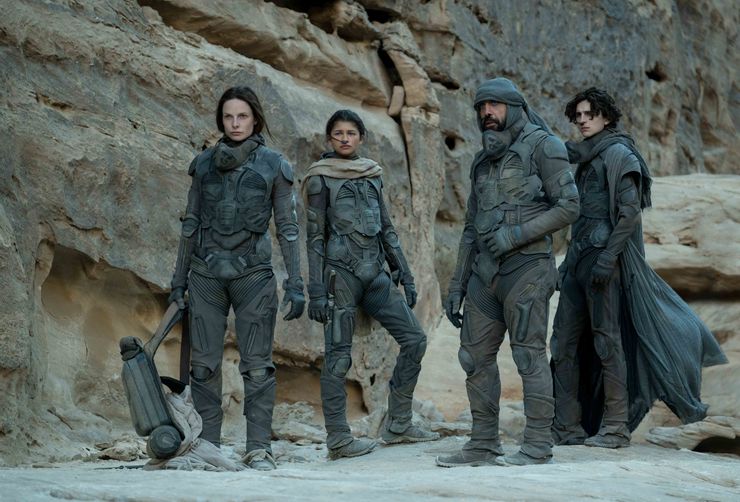
(From left to right) Rebecca Ferguson, Zendaya, Javier Bardem, and Timothee Chalamet
That said, as with any adaptation of a novel or novels as rich in detail as Dune, Villeneuve has to sacrifice key aspects of the novel in favour of an adaptation that is worthy of a 155minute feature. Certain characters like Gurney Halleck (Josh Brolin), Thufir Hawat (Stephen McKinley Henderson), and Liet Kynes (Sharon Duncan-Brewster) become side-lined more than others where in the book they would play a much more pivotal role in understanding Paul and the motifs that underpin the film.
Some of those motifs include the significance of water on a planet where water is like its own currency. A film like George Miller’s Mad Max: Fury Road (2015) did a stellar job in capturing the significance of water in a largely desolate desert setting where it is treated as a controlling tool. Villeneuve’s Dune has moments where its significance is brought to light, but it never fleshes that out in a way that would make an audience member (unless you had read the book) realise the significance of the still-suits that the characters wear, or the cannibalistic like re-purposing of a deceased persons water.
But at its core, Villeneuve’s Dune is a film that pushes what the medium can achieve at this scale and is a masterful cinematic experience that epitomizes blockbuster filmmaking. The score composed by Hans Zimmer is piercing and fitting, and makes for an enthralling soundscape (which one would hope it would be given how long he has been sitting on it for a modern Dune film); the visuals are breath-taking and unlike anything I have seen in a film before where the world feels like it exists or will exist (as though Villeneuve is his own messiah who has seen the state of the world in 10,000 years); and the cast is incredibly talented and exciting to watch (especially Stellan Skarsgard as The Baron Vladimir Harkonnen in a role that echoes the muteness of his character in the Pirates of the Caribbean franchise).
For those that haven’t read the books and even those that have, Denis Villeneuve’s Dune part 1 is a breath-taking feat in filmmaking that deserves to be seen. It’s a film that places emphasis on worldbuilding and scale at the expense of some characterisation, but it is an experience that is unlike any you will have this year. It would have been great to have had a trilogy greenlit in order to explore the complexities of Herbert’s novel in greater detail, however the fact that there will be a sequel at all is a win for fans of the book, Villeneuve, and cinema.
Dune is now streaming on HBO Max until the 22nd of November and in Australian cinemas next month



 Rating Frames