Beetlejuice Beetlejuice: Tim Burton Turns Back the Clock with a Nostalgic Sequel

Rating: 4 out of 5.

Beetlejuice Beetlejuice preview screening provided by Universal Pictures.

Whether you like him or not, mesh with his unique aesthetic or run the other way, Tim Burton occupies a space in modern cinema that he’s carved from consistency: in strangeness, in the casting of brilliant oddballs, and in retaining his trusted collaborators. It’s a big reason why Beetlejuice Beetlejuice (2024), his follow-up to the now classic Beetlejuice (1988), is such a breezy experience at the cinema, one that picks up effortlessly from where its predecessor left off, and feels just as fresh and alive as it did 36 years ago.

It’s all the better, in fact, with this sequel using the foundations established in the first film and elevating them to a level of zaniness and tomfoolery that only Burton is capable of. Beetlejuice Beetlejuice plays out like a celebration of its predecessor, one that’s well thought out and that doesn’t feel like it’s had to reinvent itself for a modern audience. That’s in stark contrast to Burton’s attempt at Dumbo (2019), a film that from the outside looked like it was marred by too much intervention and creative oversight by Disney to the point where it felt like two visions clashing, with the result being a pretty mess.

Burton’s return to his own fabled creation has the opposite effect, showing a director who’s at ease and in his element, as though he needed a reset by returning to something so beloved to find his groove again. The title sequence attests to this, with a sweeping overhead shot of the town of Winter River that’s almost identical to the one he utilised in the first film; it’s a familiar, nostalgic sight, with most of the film leaning on callbacks to the original to appeal to audiences both old and new.

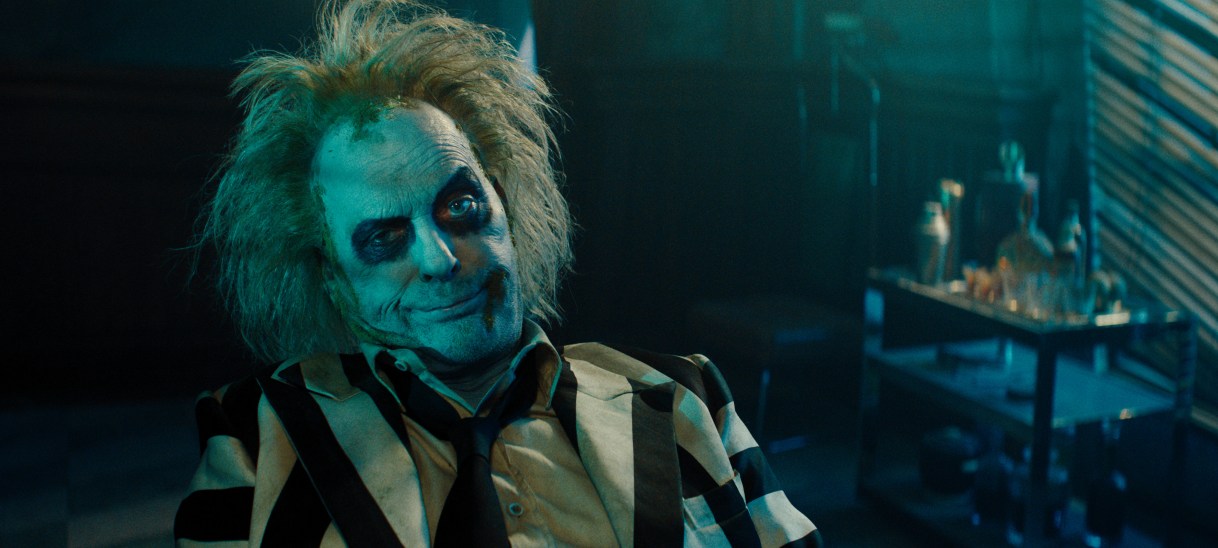
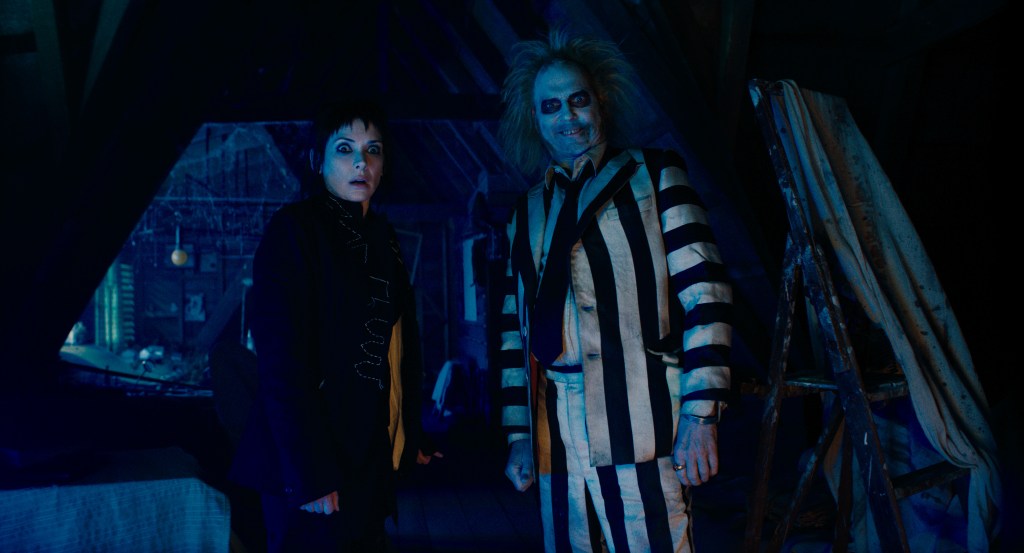
(L-r) WINONA RYDER as Lydia and MICHAEL KEATON as Beetlejuice in Warner Bros. Pictures’ comedy, “BEETLEJUICE BEETLEJUICE.”

From the overhead shot, we land on Winona Ryder’s Lydia Deetz who’s now hosting her own show on paranormal horrors as though this was an episode of Ghost Hunters. She’s still just as quirky as in the first film, but is also much more on edge as she’s clearly still haunted by her own encounter with Beetlejuice (Michael Keaton) many years ago. It could also be that her overly sleazy TV-producer boyfriend, Rory (Justin Theroux) is right up in her business trying to solve her problems the moment she gets a bit jittery; or even that her own daughter Astrid (Jenna Ortega) ignores her texts and doesn’t believe her ghost obsessions.

The truth is, it’s a mix of those things, but especially the former. Beetlejuice’s presence is still felt by the characters of the first film, including Delia (an ever so comical and hilariously bougie Catherine O’Hara), but he’ll play a key part in helping them deal with the film’s wider threats, including an old flame of his, Delores (aptly played by Monica Bellucci), who’s stapled herself back from the dead and wants revenge.

That’s not the least of the backstory that Burton traces through, with the first 25 or so minutes of the film introducing and reintroducing the film’s characters. Others include Wolf Jackson (Willem Dafoe), a dead-actor-turned-detective in the Afterlife who’s full of wits as he’s tasked with tracking down Delores, treating his job like a performance in the process. The standout of the newcomers is of course Ortega who, after her success with Burton’s hit Netflix show Wednesday, slots effortlessly into the director’s zanny world. Her chemistry with Ryder is a revelation, with their pairing singing the tune of the film and its theme around reconciliation and the bond between a mother and daughter.

(L-r) JENNA ORTEGA as Astrid and WINONA RYDER as Lydia in Warner Bros. Pictures’ comedy, “BEETLEJUICE BEETLEJUICE.”

The Afterlife itself is just as teeming with (dead) life, and looks just as vibrant and charming as it did all those years ago. It’s a testament to production designer Mark Scruton’s eye for detail as he decorates this setting with even more personality and character through his whacky designs. In fact, all of Burton’s collaborators are on their A-game, especially his regulars; Danny Eflman’s score has an ethereal quality that is reminiscent of the heyday of this genre of film, while costume designer Colleen Atwood once again dresses the cast to impress, to the point where one’s eye is naturally drawn to all characters lurking in the background.

There’s rarely ever any wasted space in a Burton film which is something that all filmmakers working in tight runtimes should aspire to. Every frame feels well thought out, every gag is executed cleanly and every prop feels like it’s just where it needs to be. Keaton has more screen time this time around as well, but everyone gets a share of the spotlight. There’s even time for a Chucky-esque demon baby-Beetlejuice, a room full of awkward Bob-like, small-headed, big-bodied beings, and a ‘Soul Train’ that —befitting to its name— transports soul musicians (and has wider implications in the plot). It’s a film that feels like it was made for the 80s gothic B-movie scene, was somehow never shown the light of day, but was unearthed at the right time.

Beetlejuice Beetlejuice opens nationally from the 5th of September.

Furiosa: A Mad Max Saga: George Miller’s Return to the Wasteland is just as Chaotic and Fun as Ever

Rating: 4.5 out of 5.

Melbourne premiere screening provided by Universal Pictures

How does one follow up one of the greatest action films of all time? In George Miller’s case, he doubles down: double the car chases, double the explosions, double the chaos, double what’s happening in the mise-en-scene, and double the fun. But Furiosa: A Mad Max Saga should not be seen as an attempt to outdo Mad Max: Fury Road (2015), even though it speaks (sometimes explicitly) to the idea of making something epic and memorable, as though that wasn’t already achieved with the sequel.

Tonally, visually and sonically, Furiosa is on par with Fury Road which makes complete sense for the simple reason that it’s a prequel that’s there to compliment, and there’s not someone else in the director’s seat to screw it up. It’s clear that Miller went with a ‘if it ain’t broke, don’t fix it’ mentality when approaching this film, and the result is all the better for it. The biggest deviation to be felt in Furiosa is that, while it lives in the universe of Mad Max, it isn’t about him. In fact, Fury Road wasn’t exactly about him either, with these two films carving out their own place as post-apocalyptic, operatic action epics with larger-than-life stakes beyond a bloke called Max. But nonetheless, Furiosa is the character we follow and the focal point that guides our understanding of where Fury Road begins and ends.

Taking place across five chapters, Furiosa opens with the titular character (played in youth by Alyla Browne) in the green haven she attempts to return to throughout Fury Road. After noticing bandits ravaging through the haven, she tries to sabotage their bikes and alert the rest of her people of their presence; unfortunately she’s captured in the process, leading her mother (Charlee Fraser) to give chase. Eventually, Furiosa is brought to the bandits leader, Dementus (Chris Hemsworth), who is looking for his own means of survival along with the rest of his pack of bikers.

Chris Hemsworth in Warner Bros. Pictures’ action adventure “FURIOSA: A MAD MAX SAGA,” a Warner Bros. Pictures release.

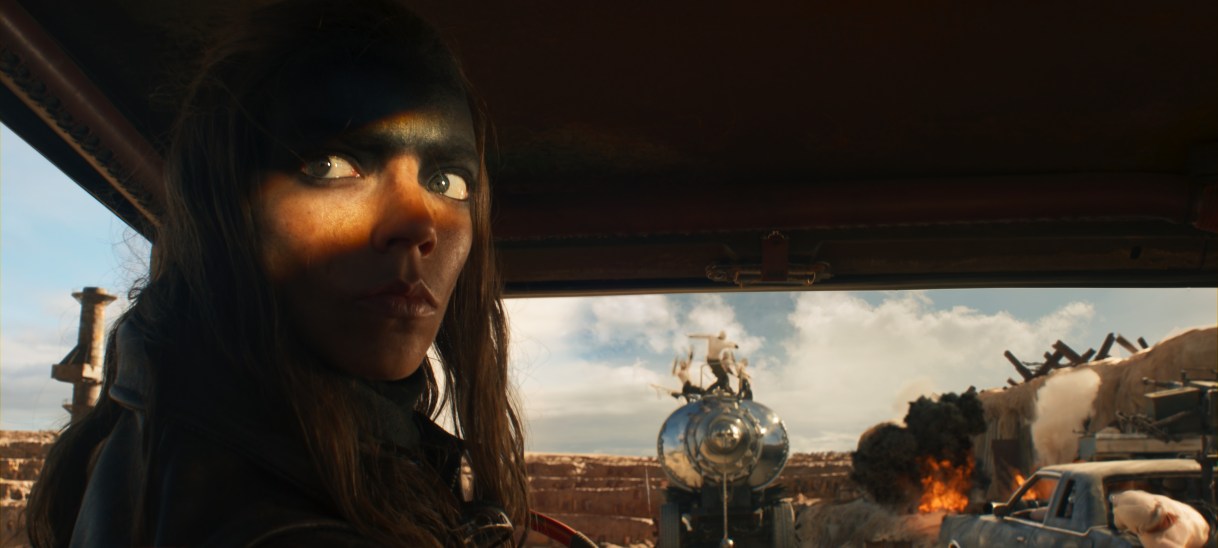
It’s from here that Miller reintroduces familiar aspects from Fury Road, namely Immortan Joe (Lachy Hulme) and his goofball sons; Immortan’s white army of War Boys; and the Citadel. The first hour or so of the film focuses on Furiosa’s navigation of this space after she finds herself a captive of sorts (for reasons I won’t spoil). Alyla Browne does a fantastic job at setting the foundations of Furiosa’s arc to the point where, when Anya Taylor-Joy eventually takes the reigns after an hour, it’s not immediately apparent because of how alike the two actresses are with their pronounced blue eyes and Miller’s focus on framing them in tight close-ups.

Once Taylor-Joy is at the helm, Miller throws her into a extended chase sequence with Praetorian Jack (Tom Burke in a minor, but effective role) onboard an oil tanker, the War Rig. It echoes the chase from Fury Road where Furiosa deviates from her oil run to Gastown, but here Miller is much more interested in stretching the tension out as much as possible, almost to breaking point. It really speaks to his penchant for destruction and his eye for detail, where every nook and cranny of the truck, gears and all, is on display and pushed to the limit.

It takes some time to buy into Taylor-Joy’s performance, namely because it feels like she trying too hard to fill Charlize Theron’s boots rather than carve out her own little space for this character. Theron’s commanding screen presence, particularly the way she carries herself, is ultimately too pronounced for Taylor-Joy — she even tries to mimic her cadence of speaking — and subtlety is more effective here (which Browne brings). But Taylor-Joy does offer a level of vulnerability through her enchanting eyes; in this sense it’s easy to see why Miller might have chosen her as the lead.

Tom Burke as Praetorian Jack and Anya Taylor-Joy as Furiosa in Warner Bros. Pictures’ action adventure “FURIOSA: A MAD MAX SAGA,” a Warner Bros. Pictures release.

Hemsworth, by contrast, steals every scene he’s in, even when he goes missing for some stretches of time. Where the Thor films misplaced his larrikin humour (often at the character’s expense), Miller gives him the freedom to lean into it in a way befitting a character with a name like Dementus. His brute physique coupled with his nasally way of speaking gives Dementus a memorable edge, especially with all of the quotable lines he’s given.

Adding to the grandiose and scale of what’s on display is the fact that the Wasteland’s harshness is felt to an equal (if not greater) degree than in the first film. The addition of locations hinted at in Fury Road, like the aforementioned Gastown and Bullettown, adds weight to the stakes at play. There isn’t just more for the sake of having more, but rather Miller deliberately leaves no stone unturned and paces his film like the War Rig barrelling down a stretch of road — there’s no room for respite, you just brace yourself and try to hold on for the ride.

For what it’s worth, it’s a gorgeous ride to be had, with the visuals once again being enveloped in this orange, grainy tinge. Where in Fury Road the colours felt less saturated, there’s a much more surreal, darker quality this time around.

This is ultimately a film about Furiosa though, and her story never feels like it’s compromised or diluted for the sake of brandishing all of the fun and games that audiences will expect. Miller is a master at knowing how to capture human plight and not let it be overshadowed by the scale of his pictures. The human element of his films and this portrayal for struggle is what intensifies every car flip, gun shot and extraordinary set-piece, which is why it’s even more commendable that in a film full of incredible moments, Furiosa never loses sight of Furiosa.

Furiosa: A Mad Max Saga opens nationally from the 23rd of May.

Three Mad Max Theories that Change How You See the Franchise

Of all the cultural exports to emerge from Australia, arguably none is more widely recognised or celebrated than the Mad Max film series. These post-apocalyptic, dystopian tales have inspired praise and enthusiastic fan-bases the world over, from Asia to the Americas, all enamoured by the franchise’s idiosyncratic characters, punk-like aesthetics, and high-octane action sequences.

This popularity is quite remarkable when one considers the franchise’s humble origins. The initial Mad Max (1979) was conceived by its director, George Miller — a qualified surgeon — as a means of highlighting the impacts of road trauma, with the hallmarks for which the series is most-widely known not being introduced until its sequel, two years later. And even then, it is never directly stated nor explained why, or how, Max’s world operates the way it does.

This mystique has led to several theories from cinephiles, some of which help explain discrepancies that have emerged in the franchise’s four-picture, five-decade history. With the latest film in the long-running saga, Furiosa set to reach our screens this week, we’re sharing three of our favourites. Spoilers follow!

Max is Dreaming
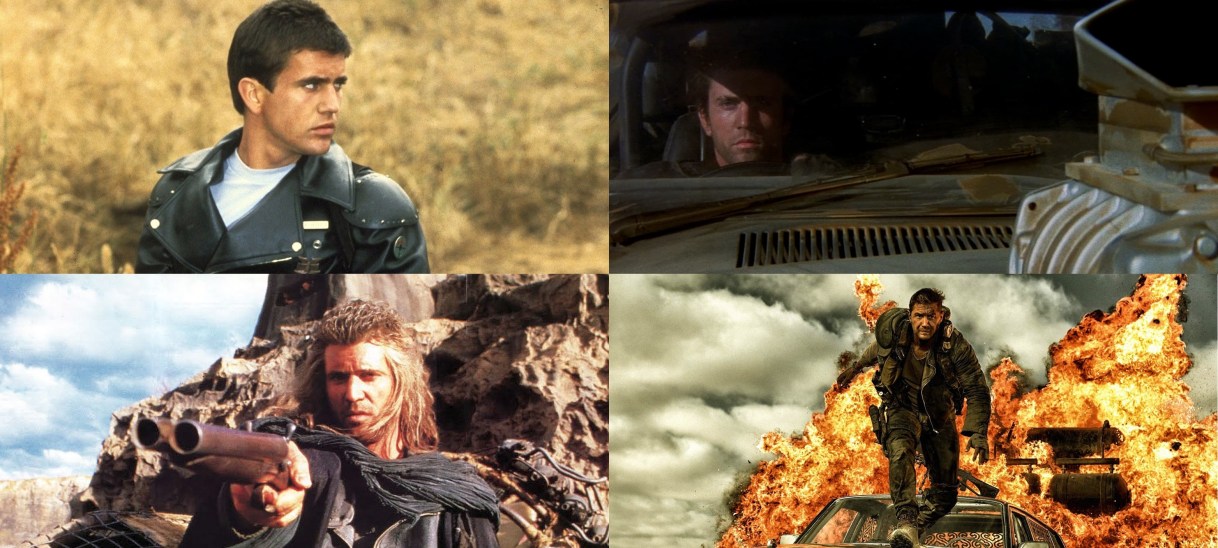
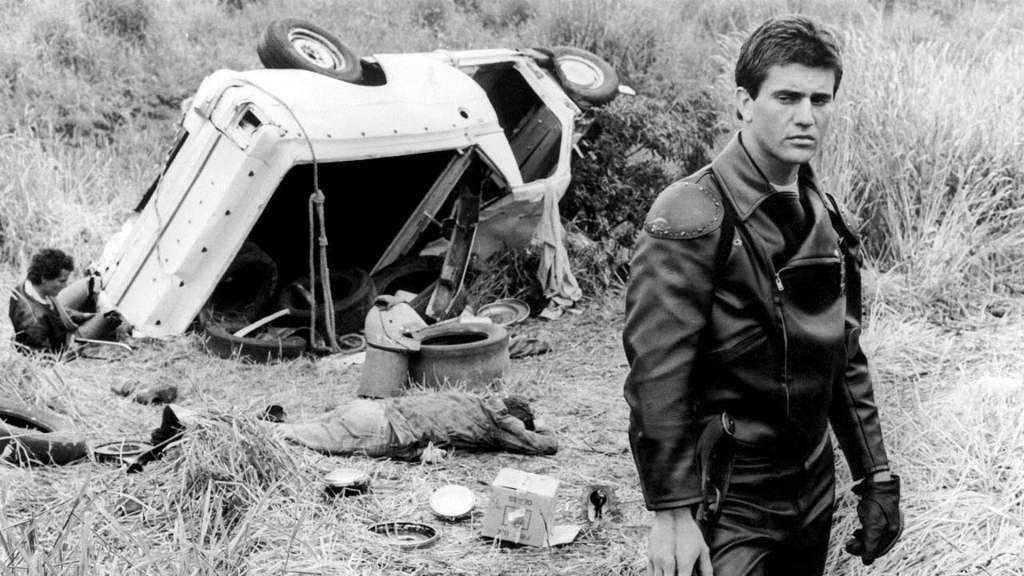
Max Rockatansky (Mel Gibson) as he appears in the final moments of the first Mad Max

This first theory postulates that our main protagonist, Max Rockatansky is imagining the events which occur in the second, third and fourth entries in the series, and stems from what transpires in the first picture. As a reminder: Max (Mel Gibson) loses his best mate, Jim “Goose” Rains (Steve Bisley), wife Jessie (Joanne Samuel) and infant son Sprog (Brendan Heath) to the violent hands of a rogue biker gang, led by The Toecutter (Hugh Keays-Byrne).

The argument here is that Max, having been distressed by the loss of those closest to him, becomes listless and descends into madness — hence the title — by entering a fantasy world of his own creation, one where he gets his revenge on Toecutter and his minions. From there, he visualises himself as a champion of the oppressed, committing vengeance against those who dare to stymie the peaceful will of others.

Applying the Caligari-esque mentality of it all being a dream may appear juvenile, but there are some elements which help provide credence to this belief. Note how, for instance, the respective plots of Mad Max 2: The Road Warrior (1981), Mad Max: Beyond Thunderdome (1985) and Mad Max: Fury Road (2015) all have Max entering a cult as an outsider, becoming their leader in all but name, and defeating their oppressors in a climactic chase sequence.

The theory also explains the use of certain actors in more than one film. Bruce Spence is a prime example — he plays the Gyro-Captain in The Road Warrior, and then appears as an amateur pilot in Beyond Thunderdome, both times assisting Max and his allies as they escape tyranny. Then there’s Max Fairchild, who appears in supporting roles in the first and second instalments; and Toecutter himself, Hugh Keays-Byrne, who portrays Fury Road’s antagonistic Immortan Joe over three decades after his first casting as a villain.

Max is a Legend
Max (Mel Gibson, again) with The Ones Left Behind in Mad Max: Beyond Thunderdome

By that, we mean he’s a mythical figure, akin to the Roman or Greek gods written about centuries ago. A couple of the examples used above could also be utilised as evidence for this second theory — the appearance of thespians as different characters in multiple films; the vaguely similar narratives of the three sequels — and more besides.

The Road Warrior is the entry which most readily identifies with Max Rockatansky being a myth. From the outset, it’s made clear the story is set in the future, with an elderly man (voiced by Harold Baigent) recounting the events of his past, who by story’s end reveals himself to be one of Max’s allies: the Feral Kid (Emil Minty).

More proof comes from the end of Beyond Thunderdome, where an adult Savannah Nix (Helen Buday) is seen recounting the tale of how she and her fellow tribespeople were rescued by Max. And then, there’s this quote which appears at the end of Fury Road:

“Where must we go… we who wander this Wasteland in search of our better selves?”

That line is attributed to “The First History Man”, and unknown and unwitnessed figure who, we can assume, is responsible for telling Max’s story.

Also indicative of this theory is the demise and unexplained return of Max’s iconic car, The Interceptor. This heavily-modified Ford XB Falcon Hardtop was stolen by Rockatansky in the third act of the original film, and destroyed in Mad Max 2, only to miraculously appear in the opening scenes of Fury Road (though in fairness, Miller circumvents this plot-hole by describing the latter picture as a “revisiting” of the franchise).

There’s More than One Max
Max (Tom Hardy) strapped to the front of a War Boy’s car in Mad Max: Fury Road

In the days and weeks following the release of Fury Road, there were certain netizens who hypothesised that this particular Max is, in fact, the aforementioned Feral Kid from Mad Max 2, owing to his long hair, the return of The Interceptor, him being played by a different actor, and the character reluctantly sharing his name.

Miller himself entertained this idea when queried by IGN, labelling it “interesting” but ultimately dismissing it, pointing to The Road Warrior’s end narration. Other factors that work against the premise include Tom Hardy being directly credited as “Max Rockatansky” in Fury Road’s opening, and his voice-over where he directly states:

“Once I was a cop, a Road Warrior searching for a righteous cause.”

But, tying into the theory that Max is a fable, it is possible that he is not the only “Max” in this universe. Again, The Interceptor helps provide weight to this theory — if this is the same Max we saw in Road Warrior and Thunderdome, how is it that “the last of the V8s” (as the car is labelled in the first and second chapters) is still in his possession after being lost?

There’s the matter of his name, too. Rockatansky only says his name twice in Fury Road — in the initial voice-over, and in the third act when he saves Furiosa’s life; he shares it about as often in Mad Max 2, and doesn’t utter it even once in Thunderdome, where he’s instead called “the Raggedy Man” or “the Man with No Name”. Perhaps our History Folk are telling of several figures who came to the aid of others, and just so happen to have named their hero “Max” in each tale.

Furiosa: A Mad Max Saga is screening in theatres nationwide from this Thursday, May 23rd. The other four Mad Max films are available via home-video, streaming and on-demand services.

Kingdom of the Planet of the Apes is a Worthy Entry in the Enduring Franchise

Rating: 3.5 out of 5.

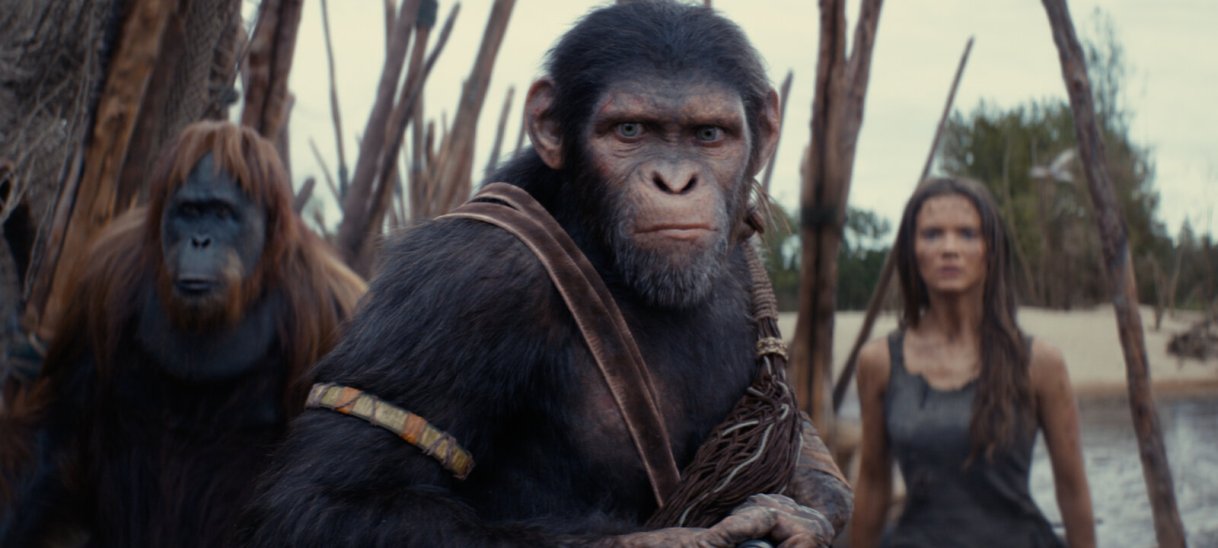
The under-the-radar but always enjoyable sci-fi franchise, the Apes films has always impressed with its top-tier CGI department and Shakespearean approach to storytelling taken straight from the James Cameron school of action cinema. With this new entry, Kingdom of the Planet of the Apes (2024), the franchise has evolved and shifted towards a more intimate scope, without lacking its compelling and nuanced storytelling vision. This latest entry is less interested in the do-or-die existential struggle for primates and humanity survival as a whole and more interested in the young individuals (on both sides) finding their place in an ever-shifting world. The Apes films have never been more relatable than with our hero Noa (Owen Teague), a young prince to a quiet colony of apes whose avian-centric culture shuts off the outside world, focusing on the establishment of their slice of the brave new world. 

With Matt Reeves moving on to darker pastures with The Batman (2022), Wes Ball, central filmmaker for the Divergent franchise, has taken the keys to this generation-spanning tale of legacy and evolution, merging into his familiar abode of adolescents staking a claim in an uncertain, dystopian future. 

Kingdom begins with a coming-of-age trial, as Noa and his companions, Anaya (Travis Jeffery) and Soona (Lydia Peckham), attempt to climb an overgrown skyscraper (in one of many evocative world-building choices the creative team have made here), in pursuit of eagle eggs to take home. The sequence is thrilling and economical in its storytelling, as the trio swing from floor to floor, learning just enough about each character to satisfy a full film. A central tenet of this trial is to always leave an egg behind, allowing the eagle cycle to continue mostly uninterrupted. As we come to learn of other colonies throughout the film, the acceptance of the eagle clans’ place in the wider ecosystem is stark and increasingly emotional as we see Noa having to adapt and find his own place in the world.

Noa (Owen Teague) in Kingdom of the Planet of the Apes.

What allowed the trilogy of modern Apes films to maintain a strong dramatic narrative is the Caesar character, seen from birth to death, performed extraordinarily across the films by the great Andy Serkis, the king of motion capture filmmaking. Serkis gave Caesar a soul deeper than skin and fur humanity, and his absence is plainly felt here, even as technology has rapidly grown. 

Kingdom sets itself apart from the previous Apes entries with its relationship with humans through its far-future setting. Noa and his companions stumble upon the mercurial Mae (Freya Allen), a seemingly feral scavenger of a human, isolated from ape kind and potentially one of only a few humans on the continent. The film thrives when Noa is forced into trusting either Mae or the film’s domineering antagonist: the cunning and powerful Proximus Caesar (Kevin Durand). Whether Promixus is a true successor to the previous film’s Caesar is only vaguely touched upon, with both potential answers to that question compelling. This question of legitimacy and Durand’s sly performance add a richer depth of storytelling to the film’s villain, solving an issue the previous trilogy of Apes films have suffered from.

The exploration of religion in this Simian civilisation is compelling and something that was taking its first steps in War of the Planet of the Apes (2017), with the word of Caesar holding an incalculable weight, leaving an enormous hole in their society after his passing. In this new film, Ball and screenwriter Josh Friedman explore these teachings of Caesar through both Raka (Peter Macon) and Proximus. While Raka seeks to use Caesar’s words to teach cohabitation and compassion across Simian and humankind, Proximus uses the recurring “ape together strong” franchise moniker to dominate other apes, folding them into his fascist empire. 

(From left) Noa (Owen Teague), Mae (Freya Allen) and Raka (Peter Macon) in Kingdom of the Planet of the Apes.

Similar to the previous entry War, Kingdom is interested in whether this new emerging primate civilisation is inherently similar to humanity or has become similar through their knowledge of humanity’s past through the characters’ desire to survive and dominate all others. The second half shifts towards a fight for survival between Mae and Proximus to break into an American army vault, with Noa stuck in the middle, disagreeing with both. While altogether a satisfying climax, these moments feel closer to retreads of similar set pieces and ideas than anything fresh and exciting to allow Kingdom to stand on its own in this enduring franchise. 

There are suggestions of a continuation of this story at its conclusion, comically implying the franchise’s intentions to leave no stone unturned towards arriving amongst the zany 70s entries in the Apes story. But, even with our modern addiction to Hollywood IP storytelling, Kingdom of the Planet of the Apes still manages to continue developing a vision for a more interesting and creative version of franchise cinema.

Kingdom of the Planet of the Apes is in theatres now.

The Fall Guy: Ryan Gosling and Emily Blunt Amplify David Leitch’s Ode to Stuntwork

Rating: 3 out of 5.

The Fall Guy Melbourne Premiere provided by Universal Pictures

Car flips, ramp jumps, countless explosions and high tumbles are just some of the obstacles that stunt people face, and David Leitch’s The Fall Guy has them all. Leitch’s film seeks to celebrate the unsung heroes of stunts by putting two of Hollywood’s hottest properties, Ryan Gosling and Emily Blunt, in the driver’s seat and letting them run amok.

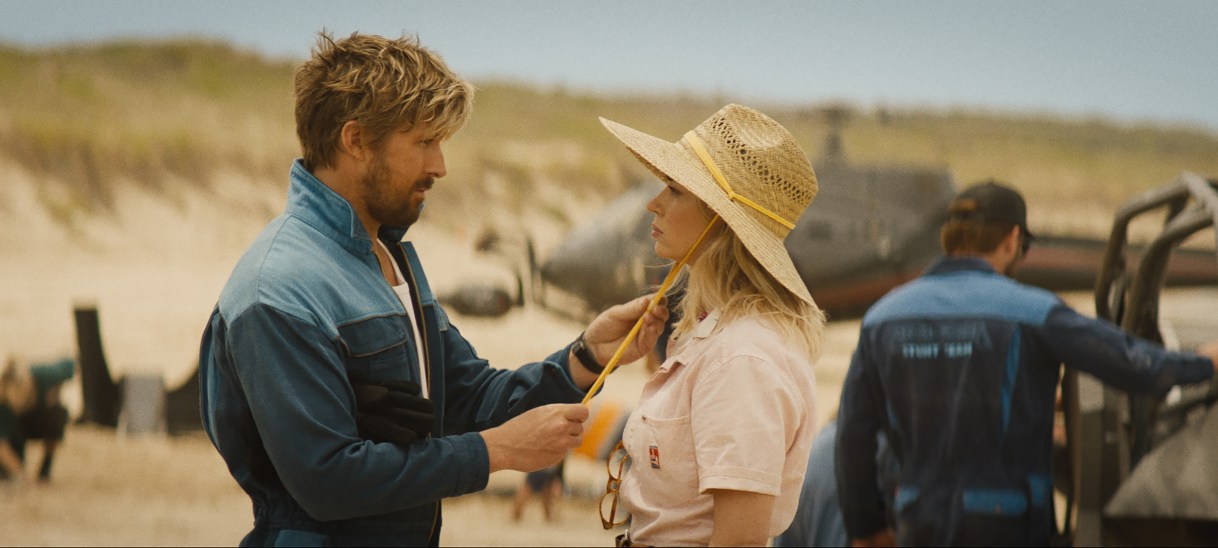
Stuntman Colt Seavers’ (Ryan Gosling) life takes an expected turn after a stunt-gone-wrong puts him out of the business for over a year. To make matters worse, he’s derailed a relationship with another crew member, cinematographer Jody Moreno (Emily Blunt) after ghosting her in the time since. But it’s not until a phone call from producer Gail (Hannah Waddingham), begging him to return to stunt work on a film that Jody is now directing, that his life really takes a turn. And that’s because amidst his awkward return to facing Jody, he’s also been tasked with locating the film’s missing star that he stunt-doubles for, Tom Ryder (Aaron Taylor-Johnson).

On paper, it’s hardly a unique premise, but it lends itself to a rampant few hours at the cinema, largely because of Gosling and Blunt’s on-screen chemistry. The duo, fresh off of their 2023 blockbuster hits Barbie and Oppenheimer, respectively, seamlessly work off of one another here.

Gosling has a penchant for dry humour, as evidenced by his straight faced delivery of lines, but he’s also an incredibly versatile actor and it shows here as he effortlessly exudes charisma —at once being able to cry in the car to Taylor Swift’s ‘All Too Well’ and then go and burst through a door like a clumsy Jackie Chan. Blunt matches him in her charm, where she finds a balance between being obliviously innocent and a straight-up butt-kicking baddie.

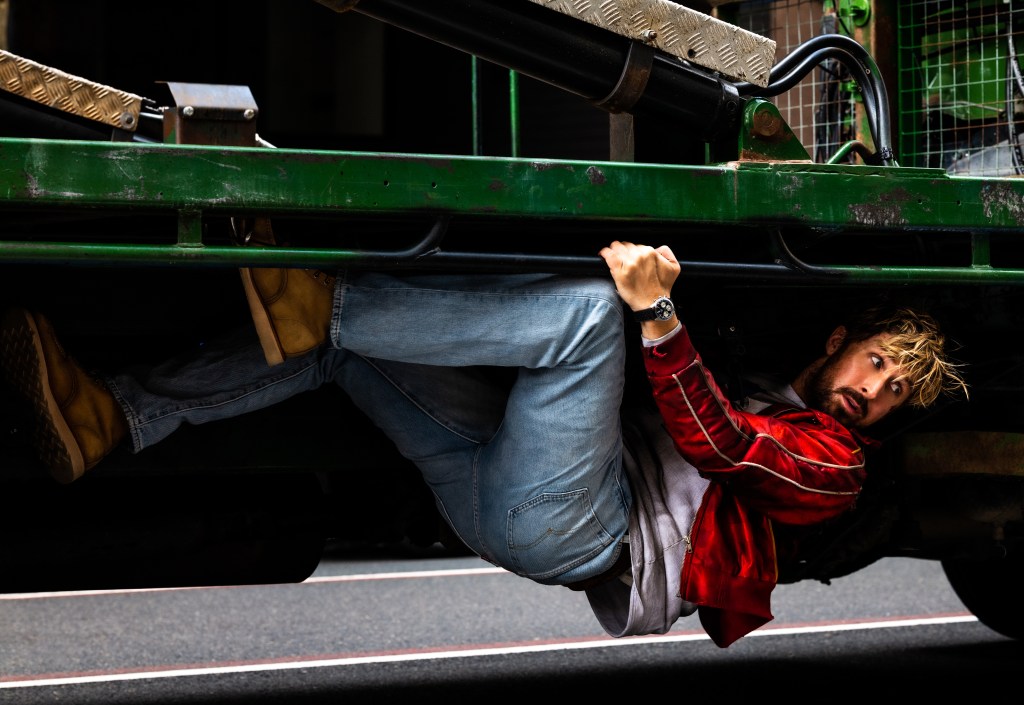
Ryan Gosling is Colt Seavers in THE FALL GUY, directed by David Leitch

The duo are really the heart and soul of the film, which sometimes gets caught up in its own self-reflexivity. Characters will often call out wider pop culture references (Winston Duke’s character slams a bad guy through a table while shouting “Dwayne Johnson!”) and sometimes the writing doesn’t take itself seriously enough, leading to a feeling that the stakes just don’t feel that important —or the wider “why should I care if you don’t” aspect that Leitch’s films are notorious for.

Make no mistake, this is a film that revels in blowing everything out of proportion, so much so that it affords little respite. There are boat chases, three major ramp jumps, a sequence where Gosling is tripping on psychedelics and seeing unicorns, street chases throughout Sydney (which has never looked better), and a closing sequence that is committed to blowing things up.

In other words, Leitch (a former stuntman himself, famously for Brad Pitt) and lead stunt coordinator Keir Beck are all-in on going as big as they can and as fast as they can. For the most part they achieve that as the film rarely gives you a moment to stop and think, at times to its own detriment (the third act resolves in a rather eye-roll moment of spewy exposition), but at the same time that’s the name of the game as stunt people rarely hesitate.

Whether or not the stunts themselves will stand the test of time in the same way Tom Cruise throwing himself off of a mountain face will, isn’t clear. For the most part they’re great in the moment, but I wouldn’t call them memorable, especially when it’s Gosling and Blunt who will steal the accolades for their effortless banter. But Leitch (like Chad Stahelski with his John Wick franchise) knows the stunt game better than anyone, and The Fall Guy delivers the popcorn filmmaking goods while celebrating the bodies behind the actors.

The Fall Guy opens nationally from the 24th of April.

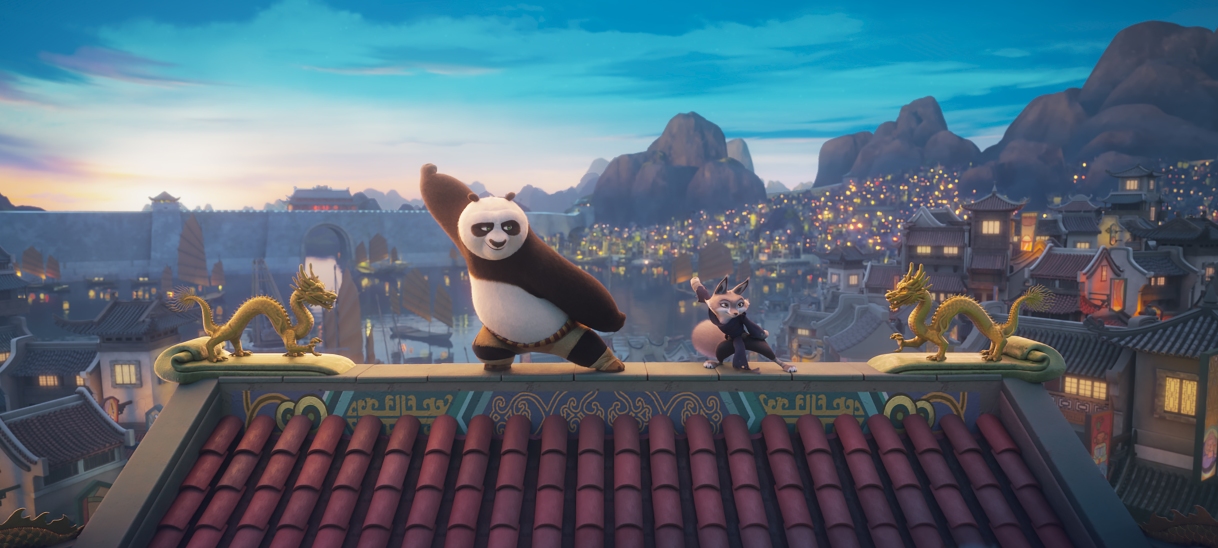
Kung Fu Panda 4: Po and Co Return for a New but Familiar Adventure

Rating: 3 out of 5.

Kung Fu Panda 4 preview screening provided by Universal Pictures

It’s been nearly 16 years since the first Kung Fu Panda film graced our screens and introduced audiences to the fun loving, butt kicking Dragon Warrior, Po (Jack Black), yet you wouldn’t think a day has passed. A large majority of older animations that have had sequels years later tend to show just how dated the animations of their predecessor are in comparison; by contrast, the latest entry in this franchise looks just as vibrant and polished as it did all those years ago.

The same can’t be said for the story, which feels like it’s treading old ground by returning a character who has reached the peak of his powers to a point where most franchises tend to begin (including this one). Eight years have passed since Kung Fu Panda 3 (2016), but as the beauty of animation so allows it, time moves much much slower. Po (Jack Black), having seemingly cleared the Valley of Peace of all adversaries and cast them into the Spirit Realm, must now select a new Dragon Warrior to take his place. As expected, this doesn’t make sense to him, no matter how much Master Shifu (Dustin Hoffman) tries to remind him that he has a new purpose to assume: that of Spiritual Leader of the Valley. Stubborn and set in his ways, he reluctantly agrees.

It doesn’t take long for his focus to shift though as word of the return of Tai Lung (Ian McShane), Po’s foe from the first film, reaches his ear. But things aren’t as they seem, with Po coming to realise a new threat has emerged in the form of the Chameleon (Viola Davis), a shapeshifter set on luring Po and his Staff of Wisdom from the Valley and enacting her own sinister plans. Naturally, Po’s curiosity gets the better of him and he decides to pursue the Chameleon along with the help of Zhen (Awkwafina), a thieving fox who agrees to take him to the Chameleon after being captured while trying to steal a bunch of precious artefacts from the temple in his town.

(Center) Chameleon (Viola Davis) in ‘Kung Fu Panda 4’ directed by Mike Mitchell.

So begins the duo’s quest from the Valley to Juniper City where the Chameleon resides. There are thrills and spills that keep them (and the audience) on edge; whether at a tavern on the brink of falling off a cliff where crooks of all sorts gather to gamble and stuff their faces, or through the streets of Juniper City where foot chases ensue —director Mike Mitchell has nailed the look and feel of the first three.

While a majority of the original cast, specifically that of the Furious Five —comprised of Angelina Jolie, Jackie Chan, Seth Rogen, Lucy Liu and David Cross— haven’t reprised their roles (much to this critic’s dismay), the heart of the film that is Po, returns with the same rampant energy and sincerity as he had in the first three films. And that’s largely owed to the cuddly and sincere Jack Black who consistently brings his A-game to any and every role he takes on. Black has carried this franchise on his voice and boisterousness alone, and he once again saddles up in the voice acting booth as though 16 years haven’t passed.

Joining him are some of those aforementioned familiar faces and voices from past entries including Mr. Ping (James Hong) and Li (Bryan Cranston) who have their own subplot as they venture out to help Po. The humour of the film is derived from their back-and-forths and while amusing, serves more as an afterthought especially in the absence of more thought-out plotting for the main quest.

(from left) Po (Jack Black) and Zhen (Awkwafina) in ‘Kung Fu Panda 4’ directed by Mike Mitchell.

As with most DreamWorks animations (and the best Disney animations), there’s always a simple moral underpinning the story. This time around it’s not being afraid of change which, in essence, was what the first film did so well in communicating especially given the stakes felt greater and Po had more to gain than lose. The message itself doesn’t lose weight per se, but it doesn’t land as meaningfully either which is perhaps owed more to the first three films rounding off really well as a trilogy and the fourth opening up threads that felt nicely closed.

Even still, Mitchell’s film is a breezy time at the cinema and never overstays its welcome. The animations are crisp and the world is teeming with goofy action that is reminiscent of the best parts of its predecessors —especially towards the closing sequence which contains some well executed kung fu fighting. Could more have been done in giving the script less of a repetitive feel? Definitely. Then again, this franchise has survived as long as it has because of Black’s penchant for comic timing and the unconventional hero arc of Po, and that’s the perfect recipe for further longevity if it so requires a fifth film.

Kung Fu Panda 4 opens nationally from the 28th of March.

96th Academy Awards: Predictions

We’re just mere hours away now from this year’s Oscars telecast, and with it, the reveal as to what America’s Academy of Motion Picture Arts and Sciences deems the most outstanding films of 2023.

Continuing a tradition that began two years prior and continued last year, our writers are once again hedging their bets as to which movies and artists will walk home with a coveted statuette.

Read on to reveal the predictions of Arnel, Darcy and Tom for the upcoming ceremony, plus who they’d most like to see emerge victorious.

Best Picture

What will win // What deserves to win

Arnel: Oppenheimer // Oppenheimer

Darcy: Oppenheimer // Killers of the Flower Moon

Tom: Oppenheimer // Oppenheimer

Best Director

Arnel: Christopher Nolan (Oppenheimer) // Christopher Nolan

Darcy: Christopher Nolan (Oppenheimer) // Jonathan Glazer (The Zone of Interest)

Tom: Christopher Nolan (Oppenheimer) // Christopher Nolan

Best Actor

Arnel: Cillian Murphy (Oppenheimer) // Cillian Murphy

Darcy: Cillian Murphy (Oppenheimer) // Cillian Murphy

Tom: Cillian Murphy (Oppenheimer) // Paul Giamatti (The Holdovers)

Best Actress

Arnel: Lily Gladstone (Killers of the Flower Moon) // Lily Gladstone

Darcy: Lily Gladstone (Killers of the Flower Moon) // Lily Gladstone

Tom: Lily Gladstone (Killers of the Flower Moon) // Lily Gladstone

Best Supporting Actor

Arnel: Robert Downey Jr. (Oppenheimer) // Robert Downey Jr.

Darcy: Robert Downey Jr. (Oppenheimer) // Robert Downey Jr.

Tom: Robert Downey Jr. (Oppenheimer) // Mark Ruffalo (Poor Things)

Best Supporting Actress

Arnel: Da’Vine Joy Randolph (The Holdovers) // Da’Vine Joy Randolph

Darcy: Da’Vine Joy Randolph (The Holdovers) // Da’Vine Joy Randolph

Tom: Da’Vine Joy Randolph (The Holdovers) // Danielle Brooks (The Color Purple)

Da’Vine Joy Randolph, nominated for her performance as Mary Lamb in The Holdovers
Best Original Screenplay

Arnel: Justine Triet & Arthur Harari (Anatomy of a Fall) // Celine Song (Past Lives)

Darcy: Justine Triet & Arthur Harari (Anatomy of a Fall) // Celine Song (Past Lives)

Tom: Justine Triet & Arthur Harari (Anatomy of a Fall) // Celine Song (Past Lives)

Best Adapted Screenplay

Arnel: Christopher Nolan (Oppenheimer) // Christopher Nolan

Darcy: Cord Jefferson (American Fiction) // Christopher Nolan

Tom: Christopher Nolan (Oppenheimer) // Christopher Nolan

Best Animated Feature

Arnel: The Boy and the Heron // The Boy and the Heron

Darcy: Spider-Man: Across the Spider-Verse // The Boy and the Heron

Tom: Spider-Man: Across the Spider-Verse // Across the Spider-Verse

Best International Feature

Arnel: The Zone of Interest // The Zone of Interest

Darcy: The Zone of Interest // The Zone of Interest

Tom: The Zone of Interest

Best Documentary Feature

Arnel: 20 Days in Mariupol // 20 Days in Mariupol

Darcy: 20 Days in Mariupol // 20 Days in Mariupol

Tom: 20 Days in Mariupol

Best Documentary Short Subject

Arnel: The ABCs of Book Banning // The ABCs of Book Banning

Darcy: The ABCs of Book Banning // The ABCs of Book Banning

Tom: The ABCs of Book Banning

Benedict Cumberbatch in The Wonderful Story of Henry Sugar, nominated for Best Live-Action Short
Best Live-Action Short

Arnel: The Wonderful Story of Henry Sugar // The Wonderful Story of Henry Sugar

Darcy: The Wonderful Story of Henry Sugar // The Wonderful Story of Henry Sugar

Tom: The Wonderful Story of Henry Sugar

Best Animated Short

Arnel: War is Over! Inspired by the Music of John and Yoko // War is Over! Inspired by the Music of John and Yoko

Darcy: Letter to a Pig // War is Over! Inspired by the Music of John and Yoko

Tom: War is Over! Inspired by the Music of John and Yoko

Best Original Score

Arnel: Ludwig Göransson (Oppenheimer) // Ludwig Göransson

Darcy: Ludwig Göransson (Oppenheimer) // Ludwig Göransson

Tom: Ludwig Göransson (Oppenheimer) // Ludwig Göransson

Best Original Song

Arnel: “What Was I Made For?” (Barbie) // “What Was I Made For?” (Barbie)

Darcy: “What Was I Made For?” (Barbie) // “I’m Just Ken” (Barbie)

Tom: “What Was I Made For?” (Barbie) // “Wahzhazhe (A Song for My People)” (Killers of the Flower Moon)

Best Sound

Arnel: Oppenheimer // Oppenheimer

Darcy: Oppenheimer // The Zone of Interest

Tom: The Zone of Interest // Oppenheimer

Best Production Design

Arnel: Barbie // Poor Things

Darcy: Barbie // Poor Things

Tom: Barbie // Poor Things

Greta Gerwig’s Barbie, nominated for Best Production Design
Best Cinematography

Arnel: Hoyte van Hoytema (Oppenheimer) // Hoyte van Hoytema

Darcy: Hoyte van Hoytema (Oppenheimer) // Rodrigo Prieto (Killers of the Flower Moon)

Tom: Hoyte van Hoytema (Oppenheimer) // Hoyte van Hoytema

Best Makeup and Hairstyling

Arnel: Poor Things // Poor Things

Darcy: Maestro // Poor Things

Tom: Maestro // Poor Things

Best Costume Design

Arnel: Jacqueline Durran (Barbie) // Jacqueline Durran (Barbie)

Darcy: Jacqueline Durran (Barbie) // Jacqueline Durran (Barbie)

Tom: Jacqueline Durran (Barbie) // Holly Waddington (Poor Things)

Best Film Editing

Arnel: Jennifer Lame (Oppenheimer) // Jennifer Lame

Darcy: Jennifer Lame (Oppenheimer) // Jennifer Lame

Tom: Jennifer Lame (Oppenheimer) // Jennifer Lame

Best Visual Effects

Arnel: Godzilla Minus One // Godzilla Minus One

Darcy: Godzilla Minus One // Godzilla Minus One

Tom: The Creator // Guardians of the Galaxy: Vol. 3

Dune: Part Two: A Sequel Worthy of Joining the Mount Rushmore of Sci-Fi Blockbusters

Rating: 4.5 out of 5.

Dune: Part Two preview screening provided by Universal Pictures

Few working directors have the capacity to deliver such audacious tentpole features like George Lucas and Sir Peter Jackson, and even fewer are able to do so authentically while ensuring that the end result is nothing short of spectacular. But that’s exactly what Denis Villeneuve has done with Dune: Part Two, his sequel to 2021’s Oscar winning Dune: Part One.

To call Dune: Part Two anything other than a generation defining Sci-Fi would be to undersell just how monumental an achievement the director has on his hands. Where Part One focused more on methodical world-building and planting the narrative seeds of Frank Herbert’s iconic novel (some might say in a much more trimmed down, thin fashion than expected), Part Two is all about scale and upping the ante.

And it picks up almost immediately after the first film, where Paul Atreides (Timothee Chalamet) has found his way to the Fremen and is working towards building their trust, learning to assimilate in their ways, and realising his potential as a Messiah. There is seemingly more pandering this time around, with the first film having the skeleton of what is sure to become a trilogy, established, but lacking that extra flesh for why we should care about these characters, the Kwisatz Haderach or any of the novel’s deeper lore.

The care for those aspects all starts with Paul though, with his plight becoming increasingly refined by screenwriters Villeneuve and Jon Spaihts, who inject more oomph into the script. Paul is much more nuanced here, having had to grow up faster than he would have liked, especially now that the Harkonnens have reoccupied Arrakis (or Dune) and are actively pursuing spice. In turn, time is of the essence for Paul and the Fremen, especially as the Harkonnens edge closer to their hidden locations.

(L-R JOSH BROLIN as Gurney Halleck and JAVIER BARDEM as Stilgar in Warner Bros. Pictures and Legendary Pictures’ action adventure “DUNE: PART TWO,” a Warner Bros. Pictures release. (PRESS KIT)

As a result the film places greater attention on the interplay between Paul and the Fremen. Fremen leader Stilgar (Javier Bardem) has become the guiding voice of reason who echoes the idea that the chosen one has arrived. He puts Paul through his paces via a series of trials that test out whether he truly lives up to all that was foretold. Whether that’s venturing out into the desert to overcome its harshness, battling the Harkonnens as they attempt to harvest spice, or riding a Shai-Hulud without guidance —there’s not shortage of incredible individual moments that both propel the narrative forward but also leave one in awe every time.

It’s in these moments that Part Two really shines and speaks to Villeneuve’s eye for detail and scale. It helps that the returning Greig Fraser (who won an Oscar for his cinematography for the first film) once again captures Dune’s deceptively beautiful vistas on a macro level, which allows that scale to shine through. Everything on Dune looks blown up in size which works to its advantage in creating this look of endlessness and enormity, a creative decision that speaks to the gravitas of the journey awaiting Paul. It’s all the more crystallised in the vibrancy of the desert colours, which further evoke that deceptive beauty of a world that will show you no mercy and swallow you whole.

For Paul, the only beauty that isn’t deceptive is that of young Fremen warrior, Chani (Zendaya). She helps him through his series of trials while continuing to hold her own as a character of interest that isn’t just sidelined to play second fiddle as a muse. Often she claps back against the popular opinion of Stilgar, and refuses to fall privy to what she sees as a cause that doesn’t exactly serve the interests of her people.

In fact, most of the female characters in Part Two play crucial roles in the film’s events, with Paul’s mother Jessica (Rebecca Ferguson) embracing her destiny as the Fremen’s Reverend Mother. Princess Irulan (Florence Pugh) has a much smaller part in proceedings as the Emperor’s (Christopher Walken) daughter, serving more as a springboard for the plot and entry point to its politics rather than anything else, which isn’t a problem per se.

A scene from Warner Bros. Pictures and Legendary Pictures’ action adventure “DUNE: PART TWO,” a Warner Bros. Pictures release.

On the flip side are the Harkonnens, with the Baron (Stellan Skarsgård) returning in his hauntingly enlarged state alongside his incompetent nephew Rabban (Dave Bautista) who is continually being outsmarted by the Fremen as he tries to gather spice on Arrakis. But it’s Austin Butler’s portrayal as the Baron’s nephew, Feyd-Rautha, that is a particular standout; he comes across across as both raw and subtle, at once menacingly distant yet eerily close.

When the Fremen do lock horns with the Harkonnens, the result is always jaw-dropping set pieces with well choreographed fights that are supported rather than supplanted by those unique visual effects. The battles are also much easier on the eye compared to a majority of recent blockbusters, in that the action is discernible rather than messy. To top it off, Hans Zimmer’s score is also complimentary rather than excessive, with his use of drums and sharp crescendos aptly suiting the various cultures and moments (I had literal goosebumps at moments as the soundscape reverberated through my seat and being).

If there was to be a shortcoming it would be that the closing sequence rounds off rather abruptly. At various points throughout the film I couldn’t help but wonder how Villeneuve would bring everything together as the finish line was becoming clearer and closer to the end. However, he had always said that this was a continuation rather than a direct sequel, and that aspect is felt, even though audiences might be left wondering by the end —with some threads left hanging.

That said, there are few directors who can create a spectacle at such a scale while leaving their own mark and remaining faithful to the source material. Dune: Part Two takes the best parts of the second half of Herbert’s novel —allegory and all— and serves them up in a digestible, refined and spectacular result that is reminiscent of some of the best sequels (or continuations) in cinema history.

Dune: Part Two opens nationally from the 29th of February.

The Sound of Christopher Nolan Movies Have Changed

With Christopher Nolan’s Oppenheimer (2023) accumulating a swathe of awards wins and nominations, including its recent 13 Oscar nominations which are all most likely to result in wins now is the opportune moment to look through the last three features of one of Hollywood’s most influential 21st-century auteurs, in particular, the use of sound in these films.

Sound has always been a primary focus in the work of Christopher Nolan, a stylistic and philosophical choice in filmmaking that has been placed at the forefront of storytelling choices since 2017’s Dunkirk, the filmmaker’s towering achievement. This forward approach to storytelling through sound carried through to the controversial Covid defining feature Tenet (2020), a bombastic and jittery experiment in how much a celebrated auteur can push an audience to their breaking point. Questions of poor mixing and dialogue decisions became the opening remarks to the film’s obituary, offhand jokes that displayed a level of creative freedom that felt a necessary evolution for modern Hollywood’s straightest shooter. Gone were the days of lifeless exposition scenes, music, and sound design cues that drew comparisons to photocopies of Michael Mann and Stanley Kubrick, with Nolan finally settling into a dynamic cinematic experience that no one in the industry can be compared to.

In the language of cinema, sound is the primary form of subjectivity. Diving into the mind of a character is profoundly more effective going between their ears than their eyes, with the right mixture of score and sound design achieving a level of symbiosis with an audience that can last a lifetime. These are ideas Christopher Nolan has been building towards in recent features, with his latest, Oppenheimer, his landmark achievement in cinematic sonic storytelling, more than likely take home multiple Oscars including best score and sound. It is his greatest film to date through its culmination of skills the revered director has accumulated over the years.

Sonically, these three films are abundantly similar even though Nolan changed several collaborators between Dunkirk and Tenet, mostly a result of scheduling issues with Denis Villeneuve’s Dune (2020), but perhaps also an indicator of a filmmaker’s style shifting as his sensibilities develop. Even though revered sound designer Richard King has worked with Nolan since The Prestige (2006) — netting himself three of his four Oscars in the process — his approach has clearly adapted alongside the filmmakers shifting ideas on how a blockbuster film can sound and how it can challenge and overwhelm an audience’s senses. 

Cillian Murphy in Oppenheimer.

Before this shift in sonic philosophy there was Interstellar (2014), Nolan’s scientifically precise sci-fi sentimentalist epic. The film has a large fanbase, with many viewing it as the auteur’s best, but its flaws of flat character archetypes floating along overly contorted plots that have plagued many a Nolan script felt like a true nadir, ushering in this new era which has opened up his style and filmmaking in exciting ways. Sound in Interstellar is used more as an absence, to create moments of awe while still maintaining the authenticity of muted space travel. There are still wonderful moments of sound however, with Hans Zimmer’s iconic score and Cooper’s (Matthew McConaughey) act of grounding himself on Earth when in orbit through a simple act of listening to the sounds of nature through headphones. What lets the film down ultimately is Nolan’s over reliance on dialogue to explain concepts he was executing wonderfully already, muting the emotional swells at every turn, particularly in its lopsided final act. 

In cinema, dialogue usually gets placed on a separate physical (in a mono track in a separate speaker in the middle of the screen) and ideological track to music and sound design for increased clarity, but this mode of thinking has shifted for Nolan since Dunkirk. In the film, King and Nolan decide to democratise dialogue in the cinematic hierarchy, allowing the full breadth of audio to translate the stories being told. This approach challenged audiences’ ears, a rarity in American cinema, especially large-scale studio films, that should be commended even if you don’t agree with the result.

This is also where Nolan’s evolution as a screenwriter starts to deviate in strange and compelling ways after Inception (2010) and Interstellar. With Dunkirk, there is little characterisation or dialogue in general, with actors like Mark Rylance and Tom Hardy playing archetypes that give way to the overwhelming war narrative they find themselves trapped within. The film, now alongside Oppenheimer, is Nolan’s greatest cinematic achievement as it highlights all of his talents as a visceral filmmaker while avoiding all of his classic pitfalls: female character punishments as motivation for male characters, over-explaining concepts, and basic protagonist arcs based on core American archetypes. Nolan’s films have now become more akin to cinematic symphonies, where the artistic goal is a full sensory experience, guided through sound, to tell a simple yet engaging story.

Robert Pattinson and John David Washington in Tenet.

In Tenet, John David Washington’s character is literally called Protagonist, a nod of self awareness that allows the kinetic energy to overwhelm the audience instead of attaching ourselves to any characters, a wild filmmaking decision that works as a creative exploration in audience engagement, one that ultimately creates a hard ceiling for the film’s quality overall. Make no mistake however, there is not an absence of expository dialogue in the film. In fact, the film is mostly expository scenes with very little room given to characterisation or emotionality, but it is in the delivery method of these dialogue dumps that expresses to an audience that the words being said are only part of what is being portrayed in the moment. In understanding Nolan’s creative decision making with Tenet, there is no better scene than Neil’s (Robert Pattinson) walkthrough of the freeport before the heist. 

With the dial cranked to eleven with Tenet, Nolan rolled back these experimental concepts of cinematic sound and narrative to a surprising sweet spot that will see him recognised by his peers at the Academy Awards. Oppenheimer‘s dialogue is stickier than his previous two films, brandishing the weight of historical record to great effect. The film is clearly detailed in its research from this time, taken often from the book American Prometheus by Kai Bird and Martin J. Sherwin that the film is adapted from, which has allowed Nolan to ground the reality of the story, opening up space to create this vivid exploration in subjectivity and purpose, led through sound. Oppenheimer’s dialogue is not positioned on the sonic field as liberally as it is in Dunkirk or Tenet, valuing the historical accuracy of the people and events involved. It is, however, greatly influenced by the exploration Nolan and King took across those films, landing in a Goldilocks zone of sonic potency that is sure to define his future filmography.

Outside of Memento (2000) with its deliberately unreliable protagonist, all of Nolan’s lead characters have clear, defined minds that an audience can attach themselves to and connect with, until J. Robert Oppenheimer, a notably obtuse and withholding historical figure that even his closest friends and allies struggled to get inside the mind of. In Oppenheimer, the brilliant music and sound design allow us an entry point into an artist’s interpretation of this challenging mind through deep subjectivity, ideas that Nolan has never felt comfortable exploring until now.

Tom Hardy in Dunkirk.

It is impossible to talk about the relationship Nolan has with sound without delving into how music is used in his films, something that has also expanded in recent years. With a clear allergy to song cues, Nolan views the use of music and score like an opera, crashing waves that hurdles an audience towards the rocks of the drama.

In Dunkirk, much was made of Nolan and Zimmer’s collaborative writing through their mutual interest in the sonic phenomena of Shepard tones as both a film score and script writing exercise. In brief, Shepard tones are a phenomenon where a bass frequency either ascends or descends alongside another tone an octave high which creates an audible illusion of a perpetually ascending or descending sound. Zimmer used this as a jumping-off point for his tension-filled score, with Nolan using the Shepard Tone concept in line with the three intercut narratives to give the audience a similar sensation of perpetual movement and tension. At the time this was a radical approach to blockbuster filmmaking to offer little respite to an audience’s eardrums, but has now developed into Nolan’s post-Interstellar style.

Like Nolan, we will work nonlinearly here in regards to Ludwig Göransson’s work with the filmmaker, as his film score for Oppenheimer is in much closer discussion with Dunkirk than Tenet, his first collaboration with the director. Perhaps bluntly but no less affecting, Göransson’s score focuses on descending pieces in a work of musical allusion to the dropping of the bomb. Göransson’s piece “Can You Hear The Music” defines the film, with its swirls of strings, horns, and synths, beginning in a swell of glorious ascension, before plummeting down through descending scale progressions that are an inversion of the ascending progression. The piece also changes tempo up to 21 different times (from 180bpm to 350bpm!) in a deceptively short piece of music, placing us within the manic Neuron sparks of Oppenheimer’s brain that everyone in the film and in the audience is trying to match the wavelength with. Of all the incredible technical achievements that define the success of Oppenheimer from the editing, cinematography, performances, and production design, perhaps the most impressive artists involved in the production are the violinists that beautifully performed this piece in one take. The stuff of legends.

The film’s near-constant score which focuses on descending scales, accentuates the creeping dread that permeates the fringes of the film leading up to the Trinity test. Most of this frenetic opening two hours operate as a whirlwind of character establishments in tight office spaces and classrooms that can at times feel like Nolan directing an episode of Genius (2017) through the lens of his and Tenet editor Jennifer Lame’s emerging house-style. Where Nolan matches Göransson’s ominous tone is fascinating. With an early scene of Oppenheimer injecting cyanide into his Cambridge professor Patrick Blackett’s (James D’Arcy) apple (a disputed event in the man’s complicated life), Nolan is highlighting the undercurrent of malice and potential valuation of those that hinder his progress in his being that matches the tone set from the outset by Göransson’s score.

Cillian Murphy in Oppenheimer.

In Göransson’s first project with Nolan, Tenet, the composer centred his score on a layering of guitars, altering its structure through time shifting and inversion, mirroring the film’s text that has become more and more crucial to Nolan’s filmmaking process. This shift in ideology can be felt more prominently in the differences between Göransson’s work on Tenet and Hans Zimmer’s work on Interstellar. While Zimmer’s work on Interstellar is perhaps some of his best compositionally (Cornfield Chase is a masterpiece), it often soars above the film instead of permeating its core. Nolan asked the famed composer to write pieces with clear restrictions on information about the narrative which certainly allowed Zimmer to write freely, but in contrast to the following features, lacks that cohesion that allows those films to thrive.

In Oppenheimer, what allows the sound design to weave seamlessly throughout the continuous score is Göransson’s removal of any percussion. By removing this floor, King and the sound design team were able to oscillate between stabilising and destabilising the audience, matching the mind of Oppenheimer scene to scene as it is splayed out on the brilliant Cillian Murphy’s anguished face, at will. King and Göransson have a tremendous cinematic chemistry, striving for the mountainous peak of Walter Murch and David Shire in the masterpiece The Conversation (1974).

Blending sound design with score, there are sounds and music compositions that emit a mechanically demonic presence, with its metallic jittering edges and sub-bass heartbeat, which are used in the scenes leading up to the Trinity test sure to be a defining moment in Nolan’s storied career that becomes an overwhelming experience, titled “Ground Zero” in the soundtrack.

The explosion itself, the culmination of the previous two hours of manic motion of montage editing, near constant score (the first non scored scene doesn’t arrive till around the one hour mark), and propulsive soundscaping, is shown in near silence, opting instead for the introspection achieved through Oppenheimer’s anxious breaths. What else could be said in a seismic moment like this? Across three films, Nolan pulverises you with an almost constant barrage of overwhelming sound, but in this critical moment, he asks for your own moment of introspection. It’s impossible not to get swept up in the awe felt by the scientists at Los Alamos as a years-long theoretical exploration illuminates the desert sky in crystal clarity, but that feeling morphs into a solemn understanding of what this moment will mean for the rest of the world. In a film of chain reactions, this central colliding moment needed near silence, until the reality of its impact came rushing forwards in a world defining blast. No moment better captures the evolution Nolan has made as a filmmaker and storyteller in these past 10 years, and is why he will be rewarded come the Academy Awards.

Bob Marley: One Love: A Basic Biopic that Never Really Hits its Notes

Rating: 2.5 out of 5.

Bob Marley: One Love preview screening provided by Paramount Pictures

It’s telling that a film showcasing one of music’s most audacious artists who refused to ‘play it safe’ is the exact opposite in its approach to capturing his significance to history. Reggae icon Bob Marley is just that, an icon, which is why Reinaldo Marcus Green’s Bob Marley: One Love (2024) should feel like more than just a surface level recount of a trailblazing artist.

Unfortunately this exact problem has plagued a majority of recent films that have focused on iconic musicians. Film’s like Bohemian Rhapsody (2018), Elvis (2022) and Rocketman (2019) are all guilty of playing it too safely when it comes to taking a historical figure and adapting their story from a fictional lens. These film’s all ultimately lean too far into accuracy (or their version of it) at the expense of deeper character drama, a nurtured plot and an understanding that every nook and cranny of the musician’s life doesn’t need to be shown (we’ve got Wikipedia for that).

One Love falls into that category where it never really tells you more about the subject beyond what a simple google search might. If we consider A Star is Born (2018), Walk the Line (2005) and even The United States vs. Billie Holiday (2021), all of these films said more about the characters at their core through the very fact that they understood how to tow the line between fiction (of which A Star is Born is completely) and utilising drama to create tension ––– and that’s all while never losing sight of the protagonist at their core.

Marcus Green’s film picks up at a point in Marley’s (Kingsley Ben-Adir) life when he’s already reached a level of fame that has him ruffling a few political feathers. It’s a commendable point in his life to start at (in the mid-70s) rather than tracing the complete rags-to-riches story like some of the aforementioned titles.

Kingsley Ben-Adir as Bob Marley and Lashana Lynch as Rita Marley in Bob Marley: One Love from Paramount Pictures.

After being shot in an attempted murder, Marley is advised to leave Jamaica for a period of time while tensions ease at the top. This is much to his dismay since his wife Rita (Lashana Lynch) was also shot and narrowly avoided death. It proves to be a worthwhile move, with Marley finding inspiration in the UK music scene after arriving in London, and eventually releasing albums like Exodus which were undercut with political commentary and offered a twist on the sort of reggae beat he had become accustomed to in prior years.

If there’s one saving grace in a film about an iconic musician, it’s the music itself. There’s no shortage of hits that are played throughout like War, Exodus, I Shot the Sheriff, Three Little Birds and more. Fortunately they’re not showcased in the same way as the hits of Queen in Bohemian Rhapsody where they were seemingly devised on a whim and almost purely exist in that film for nostalgic purposes rather than to propel the narrative forward.

The film rounds off to a close after some 95 minutes which is a silver lining at a time where most overstay their welcome. This film doesn’t overstay its welcome and will no doubt be lopped up by an audience familiar with and intrigued by, Marley’s story. Should there have been a greater focus on accentuating that internal dialogue and sentiment Marley had towards the political situation in his country that ultimately led to his performance of unity at the One Love peace concert? Definitely. Ultimately the film gets you to that point, but the result is more of a split, cobbled-together look at key milestones rather than a deeper dive into a man who united a nation.

Bob Marley: One Love opens nationally from the 14th of February.