Kung Fu Panda 4: Po and Co Return for a New but Familiar Adventure

Rating: 3 out of 5.

Kung Fu Panda 4 preview screening provided by Universal Pictures

It’s been nearly 16 years since the first Kung Fu Panda film graced our screens and introduced audiences to the fun loving, butt kicking Dragon Warrior, Po (Jack Black), yet you wouldn’t think a day has passed. A large majority of older animations that have had sequels years later tend to show just how dated the animations of their predecessor are in comparison; by contrast, the latest entry in this franchise looks just as vibrant and polished as it did all those years ago.

The same can’t be said for the story, which feels like it’s treading old ground by returning a character who has reached the peak of his powers to a point where most franchises tend to begin (including this one). Eight years have passed since Kung Fu Panda 3 (2016), but as the beauty of animation so allows it, time moves much much slower. Po (Jack Black), having seemingly cleared the Valley of Peace of all adversaries and cast them into the Spirit Realm, must now select a new Dragon Warrior to take his place. As expected, this doesn’t make sense to him, no matter how much Master Shifu (Dustin Hoffman) tries to remind him that he has a new purpose to assume: that of Spiritual Leader of the Valley. Stubborn and set in his ways, he reluctantly agrees.

It doesn’t take long for his focus to shift though as word of the return of Tai Lung (Ian McShane), Po’s foe from the first film, reaches his ear. But things aren’t as they seem, with Po coming to realise a new threat has emerged in the form of the Chameleon (Viola Davis), a shapeshifter set on luring Po and his Staff of Wisdom from the Valley and enacting her own sinister plans. Naturally, Po’s curiosity gets the better of him and he decides to pursue the Chameleon along with the help of Zhen (Awkwafina), a thieving fox who agrees to take him to the Chameleon after being captured while trying to steal a bunch of precious artefacts from the temple in his town.

(Center) Chameleon (Viola Davis) in ‘Kung Fu Panda 4’ directed by Mike Mitchell.

So begins the duo’s quest from the Valley to Juniper City where the Chameleon resides. There are thrills and spills that keep them (and the audience) on edge; whether at a tavern on the brink of falling off a cliff where crooks of all sorts gather to gamble and stuff their faces, or through the streets of Juniper City where foot chases ensue —director Mike Mitchell has nailed the look and feel of the first three.

While a majority of the original cast, specifically that of the Furious Five —comprised of Angelina Jolie, Jackie Chan, Seth Rogen, Lucy Liu and David Cross— haven’t reprised their roles (much to this critic’s dismay), the heart of the film that is Po, returns with the same rampant energy and sincerity as he had in the first three films. And that’s largely owed to the cuddly and sincere Jack Black who consistently brings his A-game to any and every role he takes on. Black has carried this franchise on his voice and boisterousness alone, and he once again saddles up in the voice acting booth as though 16 years haven’t passed.

Joining him are some of those aforementioned familiar faces and voices from past entries including Mr. Ping (James Hong) and Li (Bryan Cranston) who have their own subplot as they venture out to help Po. The humour of the film is derived from their back-and-forths and while amusing, serves more as an afterthought especially in the absence of more thought-out plotting for the main quest.

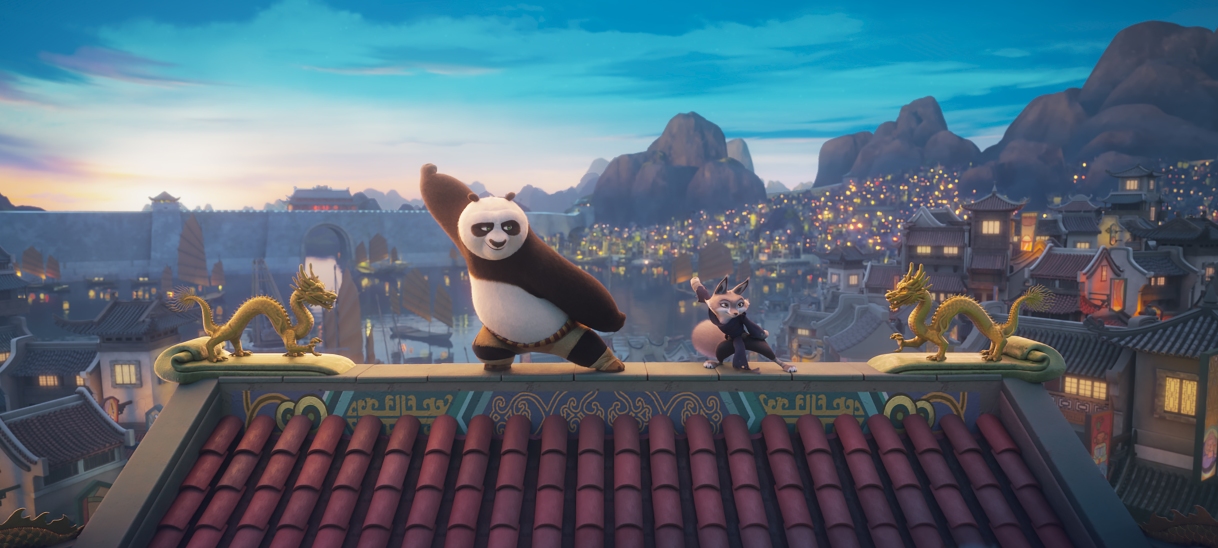
(from left) Po (Jack Black) and Zhen (Awkwafina) in ‘Kung Fu Panda 4’ directed by Mike Mitchell.

As with most DreamWorks animations (and the best Disney animations), there’s always a simple moral underpinning the story. This time around it’s not being afraid of change which, in essence, was what the first film did so well in communicating especially given the stakes felt greater and Po had more to gain than lose. The message itself doesn’t lose weight per se, but it doesn’t land as meaningfully either which is perhaps owed more to the first three films rounding off really well as a trilogy and the fourth opening up threads that felt nicely closed.

Even still, Mitchell’s film is a breezy time at the cinema and never overstays its welcome. The animations are crisp and the world is teeming with goofy action that is reminiscent of the best parts of its predecessors —especially towards the closing sequence which contains some well executed kung fu fighting. Could more have been done in giving the script less of a repetitive feel? Definitely. Then again, this franchise has survived as long as it has because of Black’s penchant for comic timing and the unconventional hero arc of Po, and that’s the perfect recipe for further longevity if it so requires a fifth film.

Kung Fu Panda 4 opens nationally from the 28th of March.

Dune: Part Two: A Sequel Worthy of Joining the Mount Rushmore of Sci-Fi Blockbusters

Rating: 4.5 out of 5.

Dune: Part Two preview screening provided by Universal Pictures

Few working directors have the capacity to deliver such audacious tentpole features like George Lucas and Sir Peter Jackson, and even fewer are able to do so authentically while ensuring that the end result is nothing short of spectacular. But that’s exactly what Denis Villeneuve has done with Dune: Part Two, his sequel to 2021’s Oscar winning Dune: Part One.

To call Dune: Part Two anything other than a generation defining Sci-Fi would be to undersell just how monumental an achievement the director has on his hands. Where Part One focused more on methodical world-building and planting the narrative seeds of Frank Herbert’s iconic novel (some might say in a much more trimmed down, thin fashion than expected), Part Two is all about scale and upping the ante.

And it picks up almost immediately after the first film, where Paul Atreides (Timothee Chalamet) has found his way to the Fremen and is working towards building their trust, learning to assimilate in their ways, and realising his potential as a Messiah. There is seemingly more pandering this time around, with the first film having the skeleton of what is sure to become a trilogy, established, but lacking that extra flesh for why we should care about these characters, the Kwisatz Haderach or any of the novel’s deeper lore.

The care for those aspects all starts with Paul though, with his plight becoming increasingly refined by screenwriters Villeneuve and Jon Spaihts, who inject more oomph into the script. Paul is much more nuanced here, having had to grow up faster than he would have liked, especially now that the Harkonnens have reoccupied Arrakis (or Dune) and are actively pursuing spice. In turn, time is of the essence for Paul and the Fremen, especially as the Harkonnens edge closer to their hidden locations.

(L-R JOSH BROLIN as Gurney Halleck and JAVIER BARDEM as Stilgar in Warner Bros. Pictures and Legendary Pictures’ action adventure “DUNE: PART TWO,” a Warner Bros. Pictures release. (PRESS KIT)

As a result the film places greater attention on the interplay between Paul and the Fremen. Fremen leader Stilgar (Javier Bardem) has become the guiding voice of reason who echoes the idea that the chosen one has arrived. He puts Paul through his paces via a series of trials that test out whether he truly lives up to all that was foretold. Whether that’s venturing out into the desert to overcome its harshness, battling the Harkonnens as they attempt to harvest spice, or riding a Shai-Hulud without guidance —there’s not shortage of incredible individual moments that both propel the narrative forward but also leave one in awe every time.

It’s in these moments that Part Two really shines and speaks to Villeneuve’s eye for detail and scale. It helps that the returning Greig Fraser (who won an Oscar for his cinematography for the first film) once again captures Dune’s deceptively beautiful vistas on a macro level, which allows that scale to shine through. Everything on Dune looks blown up in size which works to its advantage in creating this look of endlessness and enormity, a creative decision that speaks to the gravitas of the journey awaiting Paul. It’s all the more crystallised in the vibrancy of the desert colours, which further evoke that deceptive beauty of a world that will show you no mercy and swallow you whole.

For Paul, the only beauty that isn’t deceptive is that of young Fremen warrior, Chani (Zendaya). She helps him through his series of trials while continuing to hold her own as a character of interest that isn’t just sidelined to play second fiddle as a muse. Often she claps back against the popular opinion of Stilgar, and refuses to fall privy to what she sees as a cause that doesn’t exactly serve the interests of her people.

In fact, most of the female characters in Part Two play crucial roles in the film’s events, with Paul’s mother Jessica (Rebecca Ferguson) embracing her destiny as the Fremen’s Reverend Mother. Princess Irulan (Florence Pugh) has a much smaller part in proceedings as the Emperor’s (Christopher Walken) daughter, serving more as a springboard for the plot and entry point to its politics rather than anything else, which isn’t a problem per se.

A scene from Warner Bros. Pictures and Legendary Pictures’ action adventure “DUNE: PART TWO,” a Warner Bros. Pictures release.

On the flip side are the Harkonnens, with the Baron (Stellan Skarsgård) returning in his hauntingly enlarged state alongside his incompetent nephew Rabban (Dave Bautista) who is continually being outsmarted by the Fremen as he tries to gather spice on Arrakis. But it’s Austin Butler’s portrayal as the Baron’s nephew, Feyd-Rautha, that is a particular standout; he comes across across as both raw and subtle, at once menacingly distant yet eerily close.

When the Fremen do lock horns with the Harkonnens, the result is always jaw-dropping set pieces with well choreographed fights that are supported rather than supplanted by those unique visual effects. The battles are also much easier on the eye compared to a majority of recent blockbusters, in that the action is discernible rather than messy. To top it off, Hans Zimmer’s score is also complimentary rather than excessive, with his use of drums and sharp crescendos aptly suiting the various cultures and moments (I had literal goosebumps at moments as the soundscape reverberated through my seat and being).

If there was to be a shortcoming it would be that the closing sequence rounds off rather abruptly. At various points throughout the film I couldn’t help but wonder how Villeneuve would bring everything together as the finish line was becoming clearer and closer to the end. However, he had always said that this was a continuation rather than a direct sequel, and that aspect is felt, even though audiences might be left wondering by the end —with some threads left hanging.

That said, there are few directors who can create a spectacle at such a scale while leaving their own mark and remaining faithful to the source material. Dune: Part Two takes the best parts of the second half of Herbert’s novel —allegory and all— and serves them up in a digestible, refined and spectacular result that is reminiscent of some of the best sequels (or continuations) in cinema history.

Dune: Part Two opens nationally from the 29th of February.

Bob Marley: One Love: A Basic Biopic that Never Really Hits its Notes

Rating: 2.5 out of 5.

Bob Marley: One Love preview screening provided by Paramount Pictures

It’s telling that a film showcasing one of music’s most audacious artists who refused to ‘play it safe’ is the exact opposite in its approach to capturing his significance to history. Reggae icon Bob Marley is just that, an icon, which is why Reinaldo Marcus Green’s Bob Marley: One Love (2024) should feel like more than just a surface level recount of a trailblazing artist.

Unfortunately this exact problem has plagued a majority of recent films that have focused on iconic musicians. Film’s like Bohemian Rhapsody (2018), Elvis (2022) and Rocketman (2019) are all guilty of playing it too safely when it comes to taking a historical figure and adapting their story from a fictional lens. These film’s all ultimately lean too far into accuracy (or their version of it) at the expense of deeper character drama, a nurtured plot and an understanding that every nook and cranny of the musician’s life doesn’t need to be shown (we’ve got Wikipedia for that).

One Love falls into that category where it never really tells you more about the subject beyond what a simple google search might. If we consider A Star is Born (2018), Walk the Line (2005) and even The United States vs. Billie Holiday (2021), all of these films said more about the characters at their core through the very fact that they understood how to tow the line between fiction (of which A Star is Born is completely) and utilising drama to create tension ––– and that’s all while never losing sight of the protagonist at their core.

Marcus Green’s film picks up at a point in Marley’s (Kingsley Ben-Adir) life when he’s already reached a level of fame that has him ruffling a few political feathers. It’s a commendable point in his life to start at (in the mid-70s) rather than tracing the complete rags-to-riches story like some of the aforementioned titles.

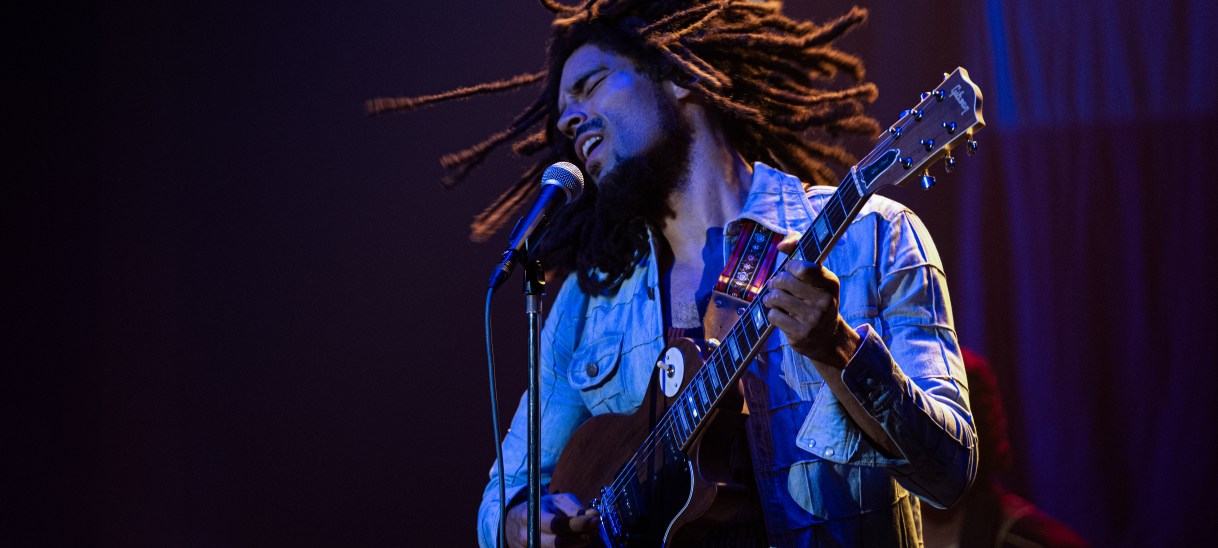
Kingsley Ben-Adir as Bob Marley and Lashana Lynch as Rita Marley in Bob Marley: One Love from Paramount Pictures.

After being shot in an attempted murder, Marley is advised to leave Jamaica for a period of time while tensions ease at the top. This is much to his dismay since his wife Rita (Lashana Lynch) was also shot and narrowly avoided death. It proves to be a worthwhile move, with Marley finding inspiration in the UK music scene after arriving in London, and eventually releasing albums like Exodus which were undercut with political commentary and offered a twist on the sort of reggae beat he had become accustomed to in prior years.

If there’s one saving grace in a film about an iconic musician, it’s the music itself. There’s no shortage of hits that are played throughout like War, Exodus, I Shot the Sheriff, Three Little Birds and more. Fortunately they’re not showcased in the same way as the hits of Queen in Bohemian Rhapsody where they were seemingly devised on a whim and almost purely exist in that film for nostalgic purposes rather than to propel the narrative forward.

The film rounds off to a close after some 95 minutes which is a silver lining at a time where most overstay their welcome. This film doesn’t overstay its welcome and will no doubt be lopped up by an audience familiar with and intrigued by, Marley’s story. Should there have been a greater focus on accentuating that internal dialogue and sentiment Marley had towards the political situation in his country that ultimately led to his performance of unity at the One Love peace concert? Definitely. Ultimately the film gets you to that point, but the result is more of a split, cobbled-together look at key milestones rather than a deeper dive into a man who united a nation.

Bob Marley: One Love opens nationally from the 14th of February.

Ferrari: Michael Mann’s Measured Portrait of Enzo Ferrari is one to Savour

Rating: 4.5 out of 5.

Driven, work-oriented men who struggle to balance the personal with the professional and are often trapped by their own desires has always been Michael Mann’s bread and butter. In Ferrari (2023), his latest foray into biopics after Ali (2001), Public Enemies (2009) and to a lesser extent, The Insider (1999), he tackles automotive titan Enzo Ferrari. A figure notorious for his desire to win at all costs, Ferrari fits perfectly into the book of self-destructive but purposeful protagonists that Mann has been exploring.

A perfectionist professionally but a loose cannon personally, Enzo Ferrari (Adam Driver) was a multi-faceted man, with his mind ever so focused on innovating and winning races but also ever so muddled when it came to his marriage and family life. Mann wastes no time in connecting those two worlds, introducing Ferrari (after a short montage of recreated black-and-white footage of a young Enzo behind the wheel) slipping out of the home of his mistress Lina (Shailene Woodley), slowly pushing a car downhill before jumping into it and speeding off. It’s a subtle introduction but helps establish what follows as a deeper look beneath the bonnet.

Where he’s speeding off to is his blindsided, somewhat estranged wife Laura (Penelope Cruz) whom he shares his struggling business with as well as a deceased son, Alfredo, whose death is a trigger point Mann continually comes back to over the course of the film to access that hidden internal layer that Enzo tries to hide.

It makes sense to ground the film to a particular moment in time rather than simply treating this as a by-the-books, cookie cutter biopic. The moment he chooses here is in 1957, with Enzo continuing to grapple with the loss of his son while living a double life with another woman and a second child, Piero. It’s a period in time where the Ferrari brand was at risk of collapse and the Mille Miglia race was a way for Enzo to clap back at doubters and hopefully, debt.

Mann is an expert at extrapolating key info from his subject matter, something Driver attests to in a Collider interview by stating that Mann’s characters “internal lives are so rich and so specific” and that “all of his notes are about character and internal life”. And Troy Kennedy Martin’s screenplay, based on Brock Yates’ Enzo Ferrari: The Man, the Cars, the Races, the Machine, offers enough legroom for Mann to build out the sort of bubbling tension that Enzo is harbouring over the course of the film where you feel that at any given moment, something will burst as it often does in his films.

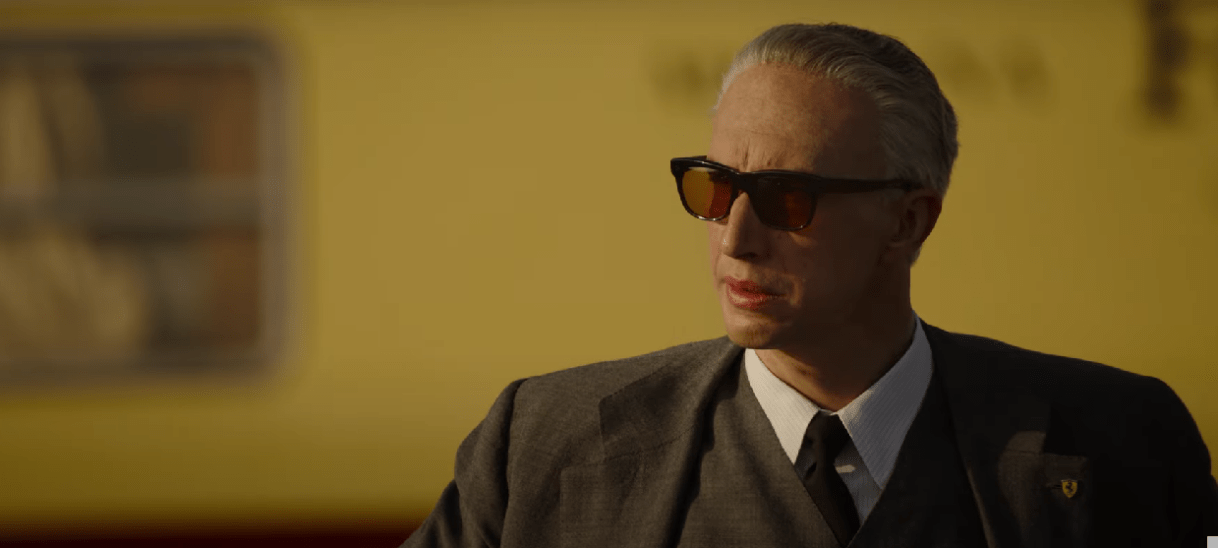
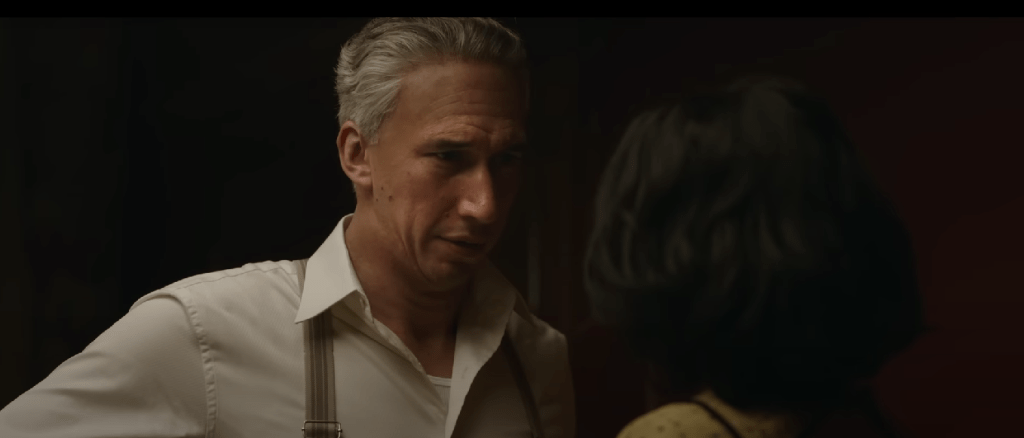
Adam Driver is Enzo Ferrari in FERRARI, directed and produced by Michael Mann

As mentioned, the Mille Miglia feels like the Hail Mary for Enzo to redeem his brand, and across the film he tests cars around a track with professional drivers while reminding them that it’s a privilege to race in one of his cars. It’s in these very transaction-like conversations that his ruthlessness and hunger to win comes through, with Driver playing the Commendatore (as he was known) with a composed edge but towering presence as though he was truly a force of nature in this world. Not to take away from Driver, but at times his performance feels a little less accessible than some of Mann’s other characters who share similar traits but often have a more engaging charisma.

It’s in the more personal exchanges he has with those he cares about that the true duality of his life comes through. Laura matches him in bluntness, with the loss of their son evidently creating a rift between the two that’s left them stagnant in their marriage. Cruz’s performance here is up there with the best of the year as she plays Laura as a woman on the cusp of losing it, with her dark, hollow eyes and blank expressions evoking the rawness she stills feels for her son’s death and distance from her husband.

While the film is more of a melodrama in its muted moments, it wouldn’t be a Mann film without some thrills and spills. The racing sequences, including that of the track tests and the Miglia itself, are shot expertly by cinematographer Erik Messerschmidt with cameras situated in seemingly every part of the car except the drivers laps. The sound-design adds to the flair of the races and the sense of foreboding doom as the cars rocket around turns and narrowly avoid knocking into each other.

The closing sequence is one of the most confronting of Mann’s career and definitely of the last year, with a crash that kills nine onlookers at the Miglia. Sure the CGI feels a bit jarring in a film that focuses on practical effects for its majority, but the moment itself and Enzo’s reaction afterwards speaks to the coolness that he projects where things happen in this line of work and you move on, because that’s what winners do, no matter the cost.

Ferrari is in theatres now.

Oppenheimer: Christopher Nolan Casts some Light on the Darkness Covering the Atomic Bomb’s Father

Rating: 3.5 out of 5.

While J. Robert Oppenheimer’s name might be synonymous with the deadliest device ever created, Christopher Nolan’s latest three hour biopic, Oppenheimer, looks at the man behind the atomic bomb through a much more introspective lens without ever insinuating that audiences should feel a sense of sympathy for his brilliant mistake/s. Of course, introspection is a key building block to any biopic, but given Nolan’s ouevre hasn’t ever focused on a historical figure of this magnitude —or any historical figure in this sense which still isn’t as big a shock as not casting Michael Caine—, there’s understandably a greater interest surrounding this biopic if not for the simple fact that it’s a Nolan film, then definitely because its subject is one of the most infamous, and misunderstood, scientific minds ever.

That Oppenheimer was a brilliant theoretical physicist who was the victim of his own belief that man could be trusted with forces larger than them, is undeniable. But Nolan’s film isn’t just concerned with the cookie-cutter facts that you can pull from a Wikipedia page. While the film is based on 2005’s Pulitzer winning novel, ‘American Prometheus’, Nolan’s interest jumps from the key, often glossed over moments in Oppenheimer’s life, and interrogates them more carefully.

Nolan’s Oppenheimer (a perfectly cast Cillian Murphy) is a man struggling to be faithful, who is always in his mind, viewing every next move like an equation on a chalkboard. His relationship to theory stretches into his everyday life as he struggles to maintain meaningful relationships, always approaching life by the numbers and relegating himself to a disconnected observer as opposed to a practical artisan. At one point he is in disbelief that scientists overseas have figured out how to split atoms from each other (or something to that effect), stating that it’s not possible from a theoretical point of view (POV), and it’s through this sort of mould that he carves his Oppenheimer from — a man unlike those around him, an outlier.

In this way, he isn’t too different from other Nolan characters like Bruce Wayne or Joseph Cooper in that he’s committed to what he knows, and does what he must for the greater good. His distant persona also affects his ability to build sustainable relationships, often pin-balling across various lovers and failing to forge a life beyond his commitment to his craft as exacerbated by a scene where he offers his crying baby to his friends as he doesn’t have the time to look after it (a selfish move he recognises).

Early in the film he’s encouraged to pursue his interest in theory and master it, and this is the point in his life that Nolan opts to introduce us to. And it’s in the early stages of the film that Nolan really portrays the internal struggle that will go on to plague Oppenheimer in the film’s later stages. He cleverly uses hazy, almost dreamlike visual motifs that equally look like beautiful stars and bomb fragments. These moments are some of the most thought-provoking as they provide a real deviation from the coolness and level head of Cillian Murphy’s performance that makes the character difficult to read — as though he’s got everything under his hat and under control.

It helps that multiple POV’s are being deployed by Nolan here in what is probably the most un-Nolan-esque part of this movie. Not only is Oppenheimer’s view of the world on display, but that of his early ‘affiliate’, Lewis Strauss (Robert Downey Jr. at his brilliant best). This duality helps build tension and allows the events of the third act to come together more tightly than might otherwise have been possible. Frequent Nolan cinematographer, Hoyte van Hoytema, shoots in colour for Oppenheimer and black and white for Strauss, further helping create this sense of separation through subjectivity and objectivity, ultimately adding to Oppenheimer’s unknowability and the difference in views that the two characters have. Whether or not this approach works in its entirety is difficult to tell from a first viewing, especially since it does tie events together, but equally throws one out of rhythm from time to time with the various timelines intersecting.

Robert Downey Jr is Lewis Strauss in OPPENHEIMER, written, produced, and directed by Christopher Nolan.

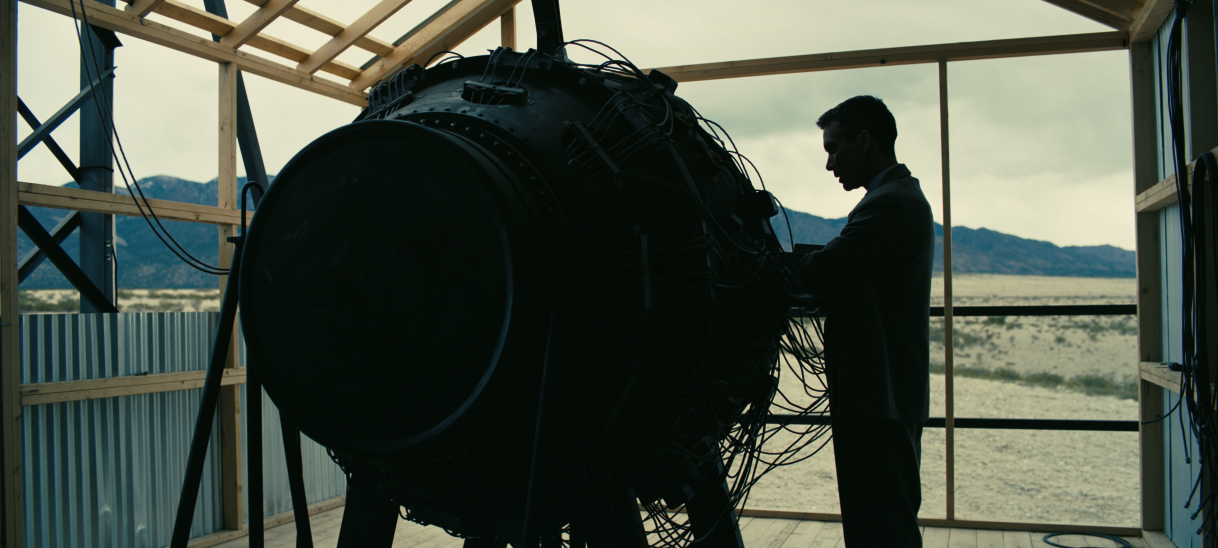
The most jarring instance of rhythmic intrusion is also the film’s best for the very fact that it’s the most speechless moment in the film. If you’ve followed the marketing, the controlled atomic set-piece (atomic in its own right) is where the full force of seeing this 70mm beast in IMAX really sells itself. By this point a lot of the establishing from the first half —namely around the politics of the Manhattan Project and the scientific lingo that will fly over most people’s heads— has been rounded off and Nolan finally gets to play with his own toys by unleashing the mother of all bombs, creating a spectacle that almost transports you to the New Mexico desert with the characters. It is really the punchline of the film, rewarding your patience by drowning out all of the noise in its countdown and the ensuing blast.

Whether or not Oppenheimer is the sort of Nolan film audiences are eager for is tough to say; there’s no tricky logic that fans of Interstellar (2014) or Inception (2010) wouldn’t wrap their heads around, but the film also sees Nolan at his rawest and most cynical, choosing to show a world destined to implode on itself just as it’s beginning to take shape. While The Dark Knight (2008) followed a similar path, there was at least the knowledge that its commentary was so distant from reality rather than a part of it. Yet in a film full of so many competing elements whether it’s the performances, the dialogue (which has has never really been the sweet-spot in a Nolan film as much as the moments around it are), the rapturous score from Ludwig Göransson, the staging of the key set piece or even the candidness of the story, there’s no doubt that like Oppenheimer, Nolan was all in on going big, and the final result is one that will stick with many long after the end credits roll by.

This post was originally published on SYN

Oppenheimer is in theatres now

Avatar: The Way of Water Sees Pandora Return Bigger and Better Than Ever

Rating: 4.5 out of 5.

Avatar: The Way of Water preview screening provided by Disney

In a year where caped crusaders have played second fiddle to F18’s and dinosaurs, Avatar: The Way of Water sees James Cameron swimming in his exclusive pool of opportunity; a sandbox style, open world, video game feeling film that is as hearty as it is beefy. Cameron, unsurprisingly, is no stranger to pushing the boundaries of what a high concept blockbuster looks like. Setting the trend with The Terminator (1984), he’s always been out to entertain first, and worry about everything else second. The Way of Water speaks to that sentiment and culminates in a sensory experience unlike any at the cinema this year.

This is, after all, a film that —like the original Avatar (2009) before it— places an emphasis on out-of-body living, on connecting with the surrounding world and learning how to nurture and care for it. Cameron, an environmental activist in his own right, made Avatar and has pursued these sequels in part because he sees them as an opportunity to raise more awareness about our own world and environment.

In The Way of Water, he follows similar concerns to that of the first film, but trades the fullness of the foresty terrain, for the breadth and depth of the oceanic surroundings. The Na’vi continue to thrive, with Jake Sully (Sam Worthington) now leading the tribe alongside his partner Neytiri (Zoe Saldana). They also have a few mini-Sully’s of their own: two sons —Neteyam (Jamie Flatters) and Lo’ak (Britain Dalton)— and a daughter, Tuk (Trinity Jo-Li Bliss). They also care for Kiri (Sigourney Weaver) who has a connection to Weaver’s character from the first film, but one that is kept intentionally vague.

The actual events of the film take place some 10 years after those of the first one. Humans continue to arrive to Pandora to harvest resources, and are even continuing to create avatars of their own. One of those is Colonel Miles Quartich (Stephen Lang), whose DNA and memories have been imbued in one of the lab grown blue beings to the point where he acts and talks like the Colonel in the first film, but he’s not him per se.

(L-R): Jake Sully, Ronal, and Tonowari in 20th Century Studios’ AVATAR: THE WAY OF WATER. Photo courtesy of 20th Century Studios. © 2022 20th Century Studios. All Rights Reserved.

In essence, the stakes feel similar: Jake and co are on the backfoot while the Sky People pursue and hunt them. Sometimes the actual motive behind this continued hunting isn’t explained all that clearly — the Colonel seems to have retained the same grudge for Sully in his avatar form as he had in his human form, but beyond that, the plot plays out like a game of hide and seek. Most of that hiding happens in the distant islands far off the mainland, where other tribes reside and have grown and learned the way of water. A good chunk of the film is spent leading up to Sully’s retreat into this unseen part of Pandora, but once out in open waters, the film opens up both visually and sonically.

Cameron has a penchant for anything aqua related, and it shows in these deep diving areas. The flora and fauna pop in ways that make one believe this world is tucked away somewhere in our own oceanic backyard. Maybe seeing all of this unfold through Cameron’s other love, 3D, might have heightened the immersion? But there is an evident care for this world that entraps and allures you, and makes you believe it’s real, if but for a split second.

It helps that the frame rate is bumped up to 48fps at certain parts. Character movements are crisp and almost life-like, where there is a fluidity to the motion. This is especially noticeable in the underwater portions of the film that are as visceral as they are breathtaking, with colours popping out like a Van Gogh painting as you try and absorb each section of the frame.

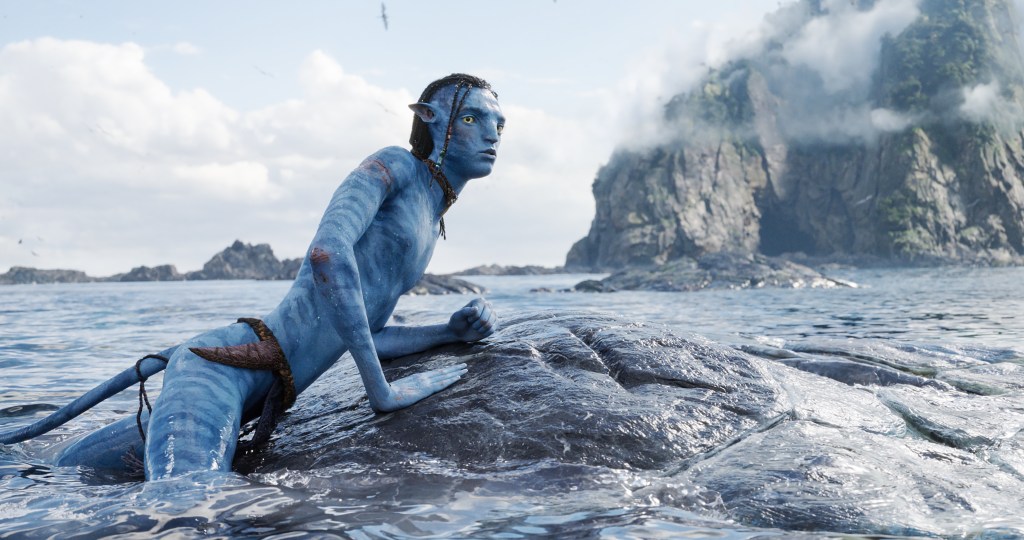
Lo’ak (Britain Dalton) in 20th Century Studios’ AVATAR: THE WAY OF WATER. Photo courtesy of 20th Century Studios. © 2022 20th Century Studios. All Rights Reserved.

Cameron makes it easy to care for these characters, who have more nuance splashed across their digital faces and more realness behind their big anime-like eyes, than any of the beings before and since Avatar. The technology is a large reason why this film works, because there just hasn’t been anything like it in cinemas previously, Avatar included. The film’s weakest link tends to be anything that isn’t digitised to the gills, like the Tarzan-esque boy Spider (Jack Champion) who was left an outcast and was essentially adopted by the Sully’s. While the film justifies his presence, it’s more jarring to spend time with anything that isn’t wholly CGI.

Cameron’s brilliance ultimately rests in his unmatched understanding of scale — of how to get all of his story points in a basket while showcasing them in the biggest way possible. He swiftly transitions from moments of bonding and connection between tribes and creatures, to large battles sequences involving these tribes and creatures as they glide over the ocean. You might not end up caring for the whale like Tulkin beasts that end up playing a more vital role in the plot than anything else, but it’s enough to believe that Cameron does. It’s a large reason he takes so long with these films, and especially with The Way of Water, as he finds that balance between telling a story about big blue people and everything in between that’s worth caring about, with the trailblazing action and scenery on display.

Even if the plot is very akin to that of the original film, The Way of Water is a sum of all of Cameron’s experiences and experiments up until now, where he pours his heart and soul into each and every frame, as though this could be the last ride in Pandora even with most of the sequels penned and planned out. The Way of Water hits like a tidal wave, and it’s worth getting drenched for.

This post was originally published on SYN

Avatar: The Way of Water opens nationally from the 15th of December, 2022.