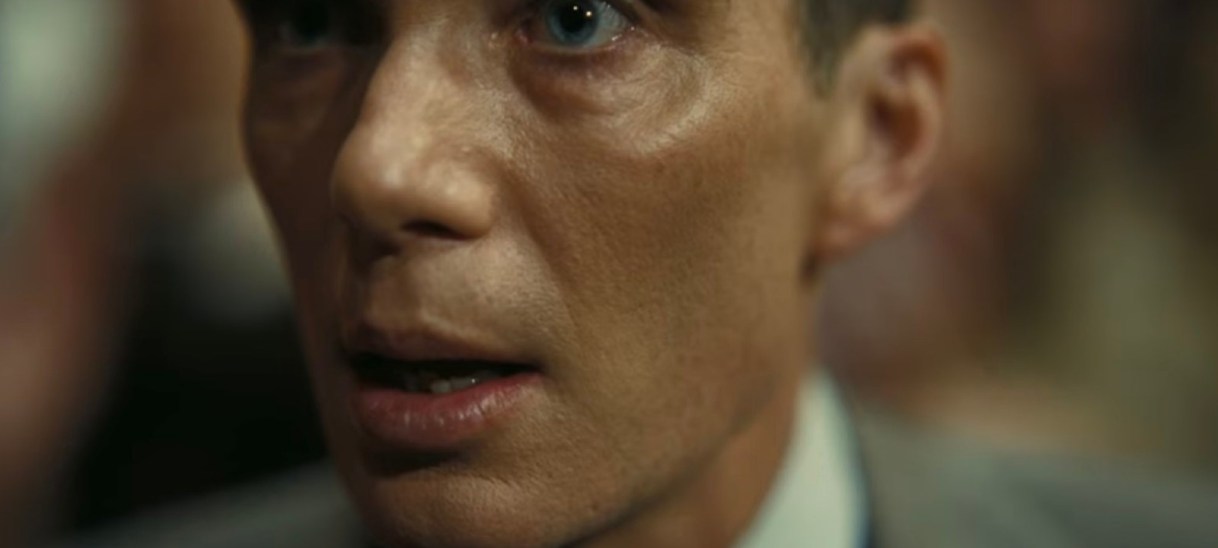
With Christopher Nolan’s Oppenheimer (2023) accumulating a swathe of awards wins and nominations, including its recent 13 Oscar nominations — which are all most likely to result in wins — now is the opportune moment to look through the last three features of one of Hollywood’s most influential 21st-century auteurs, in particular, the use of sound in these films.
Sound has always been a primary focus in the work of Christopher Nolan, a stylistic and philosophical choice in filmmaking that has been placed at the forefront of storytelling choices since 2017’s Dunkirk, the filmmaker’s towering achievement. This forward approach to storytelling through sound carried through to the controversial Covid defining feature Tenet (2020), a bombastic and jittery experiment in how much a celebrated auteur can push an audience to their breaking point. Questions of poor mixing and dialogue decisions became the opening remarks to the film’s obituary, offhand jokes that displayed a level of creative freedom that felt a necessary evolution for modern Hollywood’s straightest shooter. Gone were the days of lifeless exposition scenes, music, and sound design cues that drew comparisons to photocopies of Michael Mann and Stanley Kubrick, with Nolan finally settling into a dynamic cinematic experience that no one in the industry can be compared to.
In the language of cinema, sound is the primary form of subjectivity. Diving into the mind of a character is profoundly more effective going between their ears than their eyes, with the right mixture of score and sound design achieving a level of symbiosis with an audience that can last a lifetime. These are ideas Christopher Nolan has been building towards in recent features, with his latest, Oppenheimer, his landmark achievement in cinematic sonic storytelling, more than likely take home multiple Oscars including best score and sound. It is his greatest film to date through its culmination of skills the revered director has accumulated over the years.
Sonically, these three films are abundantly similar even though Nolan changed several collaborators between Dunkirk and Tenet, mostly a result of scheduling issues with Denis Villeneuve’s Dune (2020), but perhaps also an indicator of a filmmaker’s style shifting as his sensibilities develop. Even though revered sound designer Richard King has worked with Nolan since The Prestige (2006) — netting himself three of his four Oscars in the process — his approach has clearly adapted alongside the filmmakers shifting ideas on how a blockbuster film can sound and how it can challenge and overwhelm an audience’s senses.

Before this shift in sonic philosophy there was Interstellar (2014), Nolan’s scientifically precise sci-fi sentimentalist epic. The film has a large fanbase, with many viewing it as the auteur’s best, but its flaws of flat character archetypes floating along overly contorted plots that have plagued many a Nolan script felt like a true nadir, ushering in this new era which has opened up his style and filmmaking in exciting ways. Sound in Interstellar is used more as an absence, to create moments of awe while still maintaining the authenticity of muted space travel. There are still wonderful moments of sound however, with Hans Zimmer’s iconic score and Cooper’s (Matthew McConaughey) act of grounding himself on Earth when in orbit through a simple act of listening to the sounds of nature through headphones. What lets the film down ultimately is Nolan’s over reliance on dialogue to explain concepts he was executing wonderfully already, muting the emotional swells at every turn, particularly in its lopsided final act.
In cinema, dialogue usually gets placed on a separate physical (in a mono track in a separate speaker in the middle of the screen) and ideological track to music and sound design for increased clarity, but this mode of thinking has shifted for Nolan since Dunkirk. In the film, King and Nolan decide to democratise dialogue in the cinematic hierarchy, allowing the full breadth of audio to translate the stories being told. This approach challenged audiences’ ears, a rarity in American cinema, especially large-scale studio films, that should be commended even if you don’t agree with the result.
This is also where Nolan’s evolution as a screenwriter starts to deviate in strange and compelling ways after Inception (2010) and Interstellar. With Dunkirk, there is little characterisation or dialogue in general, with actors like Mark Rylance and Tom Hardy playing archetypes that give way to the overwhelming war narrative they find themselves trapped within. The film, now alongside Oppenheimer, is Nolan’s greatest cinematic achievement as it highlights all of his talents as a visceral filmmaker while avoiding all of his classic pitfalls: female character punishments as motivation for male characters, over-explaining concepts, and basic protagonist arcs based on core American archetypes. Nolan’s films have now become more akin to cinematic symphonies, where the artistic goal is a full sensory experience, guided through sound, to tell a simple yet engaging story.

In Tenet, John David Washington’s character is literally called Protagonist, a nod of self awareness that allows the kinetic energy to overwhelm the audience instead of attaching ourselves to any characters, a wild filmmaking decision that works as a creative exploration in audience engagement, one that ultimately creates a hard ceiling for the film’s quality overall. Make no mistake however, there is not an absence of expository dialogue in the film. In fact, the film is mostly expository scenes with very little room given to characterisation or emotionality, but it is in the delivery method of these dialogue dumps that expresses to an audience that the words being said are only part of what is being portrayed in the moment. In understanding Nolan’s creative decision making with Tenet, there is no better scene than Neil’s (Robert Pattinson) walkthrough of the freeport before the heist.
With the dial cranked to eleven with Tenet, Nolan rolled back these experimental concepts of cinematic sound and narrative to a surprising sweet spot that will see him recognised by his peers at the Academy Awards. Oppenheimer‘s dialogue is stickier than his previous two films, brandishing the weight of historical record to great effect. The film is clearly detailed in its research from this time, taken often from the book American Prometheus by Kai Bird and Martin J. Sherwin that the film is adapted from, which has allowed Nolan to ground the reality of the story, opening up space to create this vivid exploration in subjectivity and purpose, led through sound. Oppenheimer’s dialogue is not positioned on the sonic field as liberally as it is in Dunkirk or Tenet, valuing the historical accuracy of the people and events involved. It is, however, greatly influenced by the exploration Nolan and King took across those films, landing in a Goldilocks zone of sonic potency that is sure to define his future filmography.
Outside of Memento (2000) with its deliberately unreliable protagonist, all of Nolan’s lead characters have clear, defined minds that an audience can attach themselves to and connect with, until J. Robert Oppenheimer, a notably obtuse and withholding historical figure that even his closest friends and allies struggled to get inside the mind of. In Oppenheimer, the brilliant music and sound design allow us an entry point into an artist’s interpretation of this challenging mind through deep subjectivity, ideas that Nolan has never felt comfortable exploring until now.

It is impossible to talk about the relationship Nolan has with sound without delving into how music is used in his films, something that has also expanded in recent years. With a clear allergy to song cues, Nolan views the use of music and score like an opera, crashing waves that hurdles an audience towards the rocks of the drama.
In Dunkirk, much was made of Nolan and Zimmer’s collaborative writing through their mutual interest in the sonic phenomena of Shepard tones as both a film score and script writing exercise. In brief, Shepard tones are a phenomenon where a bass frequency either ascends or descends alongside another tone an octave high which creates an audible illusion of a perpetually ascending or descending sound. Zimmer used this as a jumping-off point for his tension-filled score, with Nolan using the Shepard Tone concept in line with the three intercut narratives to give the audience a similar sensation of perpetual movement and tension. At the time this was a radical approach to blockbuster filmmaking to offer little respite to an audience’s eardrums, but has now developed into Nolan’s post-Interstellar style.
Like Nolan, we will work nonlinearly here in regards to Ludwig Göransson’s work with the filmmaker, as his film score for Oppenheimer is in much closer discussion with Dunkirk than Tenet, his first collaboration with the director. Perhaps bluntly but no less affecting, Göransson’s score focuses on descending pieces in a work of musical allusion to the dropping of the bomb. Göransson’s piece “Can You Hear The Music” defines the film, with its swirls of strings, horns, and synths, beginning in a swell of glorious ascension, before plummeting down through descending scale progressions that are an inversion of the ascending progression. The piece also changes tempo up to 21 different times (from 180bpm to 350bpm!) in a deceptively short piece of music, placing us within the manic Neuron sparks of Oppenheimer’s brain that everyone in the film and in the audience is trying to match the wavelength with. Of all the incredible technical achievements that define the success of Oppenheimer from the editing, cinematography, performances, and production design, perhaps the most impressive artists involved in the production are the violinists that beautifully performed this piece in one take. The stuff of legends.
The film’s near-constant score which focuses on descending scales, accentuates the creeping dread that permeates the fringes of the film leading up to the Trinity test. Most of this frenetic opening two hours operate as a whirlwind of character establishments in tight office spaces and classrooms that can at times feel like Nolan directing an episode of Genius (2017) through the lens of his and Tenet editor Jennifer Lame’s emerging house-style. Where Nolan matches Göransson’s ominous tone is fascinating. With an early scene of Oppenheimer injecting cyanide into his Cambridge professor Patrick Blackett’s (James D’Arcy) apple (a disputed event in the man’s complicated life), Nolan is highlighting the undercurrent of malice and potential valuation of those that hinder his progress in his being that matches the tone set from the outset by Göransson’s score.
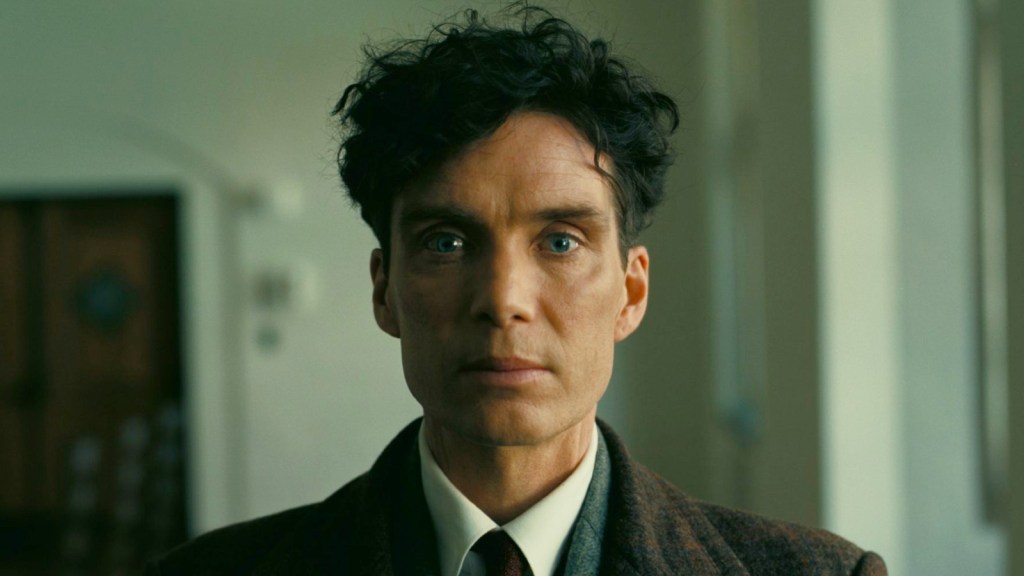
In Göransson’s first project with Nolan, Tenet, the composer centred his score on a layering of guitars, altering its structure through time shifting and inversion, mirroring the film’s text that has become more and more crucial to Nolan’s filmmaking process. This shift in ideology can be felt more prominently in the differences between Göransson’s work on Tenet and Hans Zimmer’s work on Interstellar. While Zimmer’s work on Interstellar is perhaps some of his best compositionally (Cornfield Chase is a masterpiece), it often soars above the film instead of permeating its core. Nolan asked the famed composer to write pieces with clear restrictions on information about the narrative which certainly allowed Zimmer to write freely, but in contrast to the following features, lacks that cohesion that allows those films to thrive.
In Oppenheimer, what allows the sound design to weave seamlessly throughout the continuous score is Göransson’s removal of any percussion. By removing this floor, King and the sound design team were able to oscillate between stabilising and destabilising the audience, matching the mind of Oppenheimer scene to scene as it is splayed out on the brilliant Cillian Murphy’s anguished face, at will. King and Göransson have a tremendous cinematic chemistry, striving for the mountainous peak of Walter Murch and David Shire in the masterpiece The Conversation (1974).
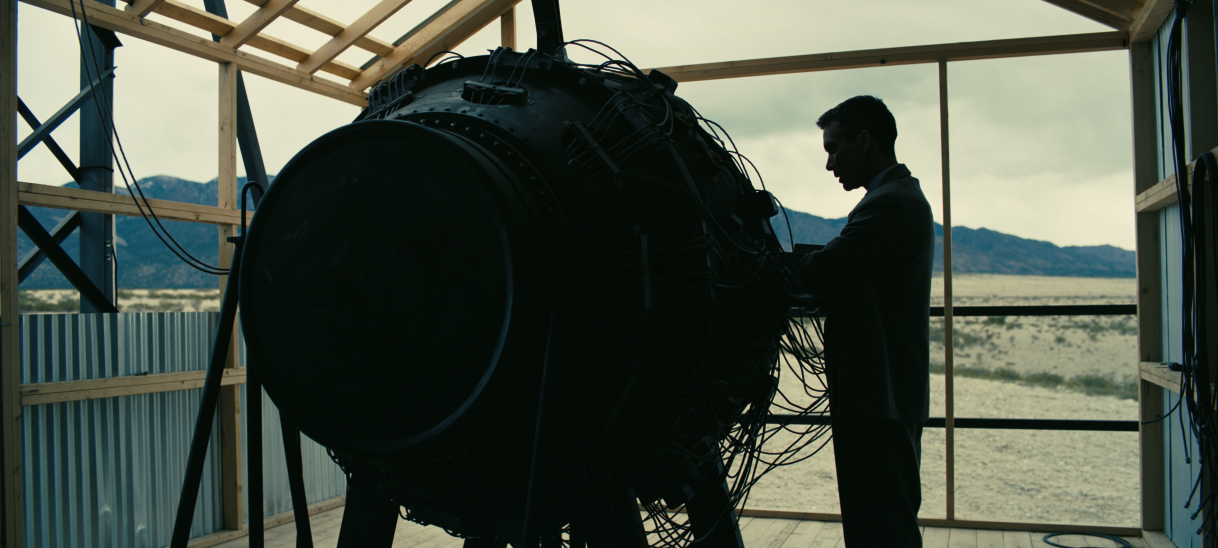
Blending sound design with score, there are sounds and music compositions that emit a mechanically demonic presence, with its metallic jittering edges and sub-bass heartbeat, which are used in the scenes leading up to the Trinity test — sure to be a defining moment in Nolan’s storied career — that becomes an overwhelming experience, titled “Ground Zero” in the soundtrack.
The explosion itself, the culmination of the previous two hours of manic motion of montage editing, near constant score (the first non scored scene doesn’t arrive till around the one hour mark), and propulsive soundscaping, is shown in near silence, opting instead for the introspection achieved through Oppenheimer’s anxious breaths. What else could be said in a seismic moment like this? Across three films, Nolan pulverises you with an almost constant barrage of overwhelming sound, but in this critical moment, he asks for your own moment of introspection. It’s impossible not to get swept up in the awe felt by the scientists at Los Alamos as a years-long theoretical exploration illuminates the desert sky in crystal clarity, but that feeling morphs into a solemn understanding of what this moment will mean for the rest of the world. In a film of chain reactions, this central colliding moment needed near silence, until the reality of its impact came rushing forwards in a world defining blast. No moment better captures the evolution Nolan has made as a filmmaker and storyteller in these past 10 years, and is why he will be rewarded come the Academy Awards.
















 Rating Frames