Wolf Man takes a Bite out of a Monster Classic

Rating: 3 out of 5.

Wolf Man preview screening provided by Universal Pictures.

It’s been nearly five years since Leigh Whannell’s Invisible Man (2020) took audiences by surprise and became an instant hit while re-imagining a classic Universal Monsters story for a modern audience. His latest film, Wolf Man (2025), written along with co-writer and partner Corbett Tuck, and based on The Wolf Man (1941), offers a fresh new spin on another classic while touching on concerns around the duality of man and beast, sickness and health.

If Invisible Man was a compact horror/thriller that cleverly utilised space, subtle pans and tilts to create brewing tension, then Wolf Man scales things back even more, focusing its events around an eerie house in a grim Oregon, foresty setting where danger lurks. It’s where Blake (Christopher Abbott), his wife Charlotte (Julia Garner), and daughter Ginger (Matilda Firth), find themselves after a short New York-set introduction reveals that his father has passed away and he’s been left with the keys to his old house.

In true horror fashion, a tight strip of road with towering trees is the first sign of the unease and helplessness that awaits, sitting in stark contrast to the bustling, comfortable concrete jungle the family is used to. And it doesn’t take long for this little getaway to go south as their moving truck tumbles off the road after veering last minute from a figure in the middle of the road. A lot happens and it happens really quickly, including Blake’s gradual transformation into his wolf-esque appearance after he contracts a disease upon realising a cut he received on his arm came not from glass but from the devious figured that sent them tumbling.

In this way, Wolf Man is paced rather abruptly, with Whannell wanting to get you into the thick of the suspense as soon as possible. It’s a less daring exercise in tension compared to his last feature and feels more routine in how it hits genre beats. There’s nothing inherently wrong in this, it just feels like a return to earlier roots in that he could seemingly tackle something like Wolf Man in his sleep.

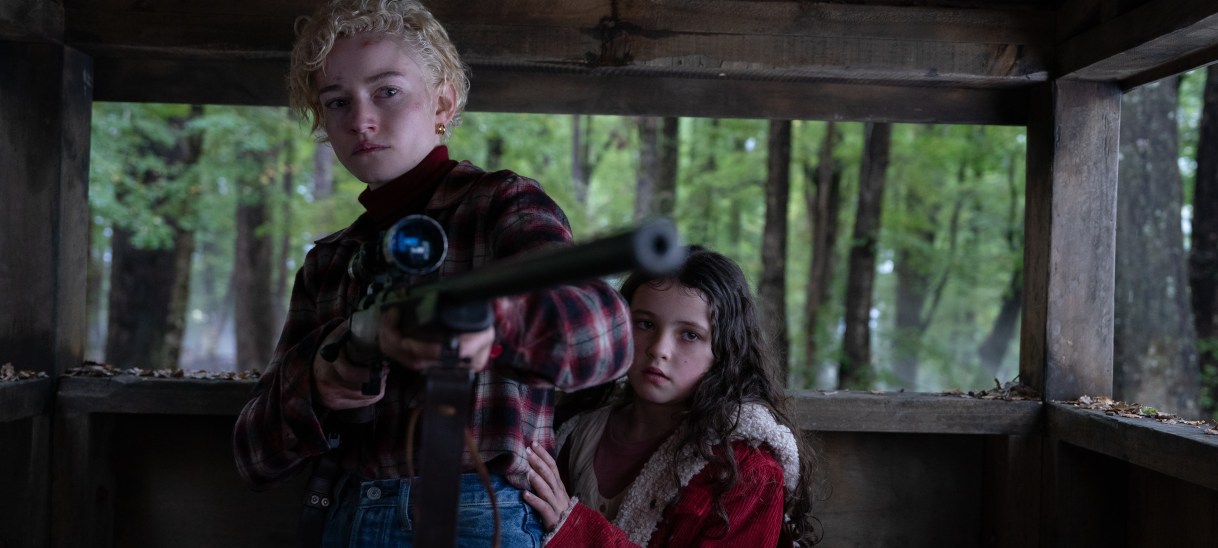
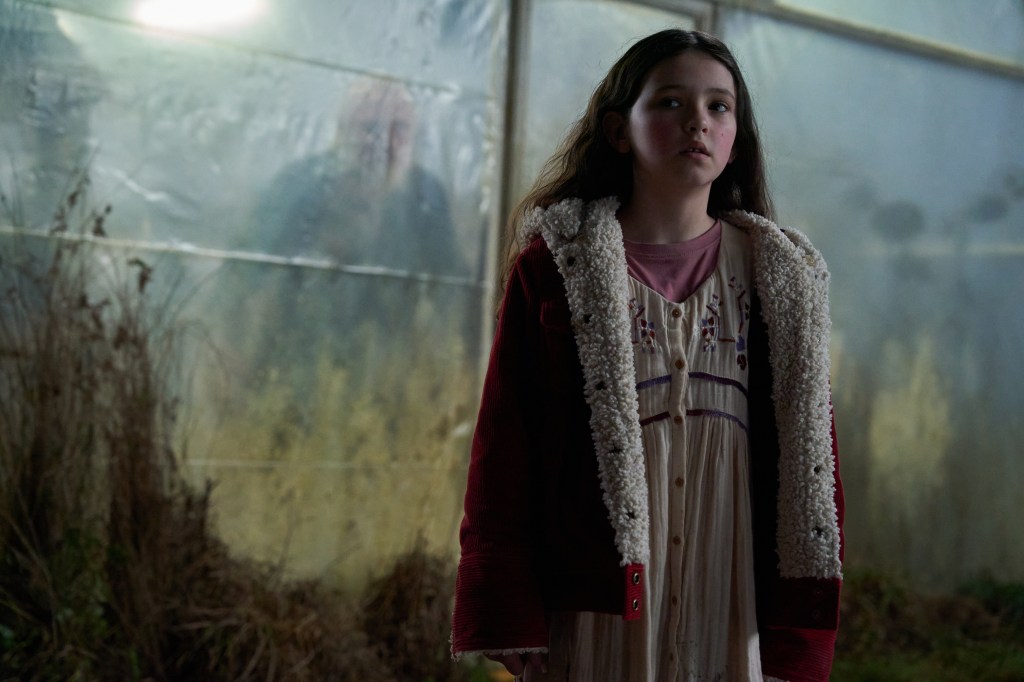
Ginger (Matilda Firth, right) in Wolf Man, directed by Leigh Whannell.

Unlike the subtly of the camerawork, which Stefan Duscio has managed to balance out quite nicely with Whannell’s stylish direction across their three film collaboration, the writing can feel on the nose at certain points like when Ginger indulges her father’s ‘guess what I’m thinking’ game at various points or the constant “daddy” and “mommy” dialogue which sticks out like a sore thumb.

Fortunately, like with Elisabeth Moss’ brilliantly grounded performance in Invisible Man, Julia Garner speaks as much through her eyes as she does through her mouth, with her signature fluttering eyelids at once conveying motherly resoluteness as she protects Ginger, while showing empathy for her husband’s deteriorating state. Her performance goes hand in hand with Whannell’s artful flourishes and Duscio’s tight camerawork, the latter of which seems to favour a more contemplative cinematic approach this time around, with shots that linger heavily before bursting to meet the frantic-ness of a chase.

There’s a few moments where the camera circles around Blake and his family and shows how his worsening state is affecting his vision, almost heightening his senses while blurring his vision to those around him; this is one of those stylistic choices that the film needed more of as it gave an extra layer to a character who might otherwise simply fall into the antagonist category.

While less horrific and more melancholic by the end, prior to the screening, Whannell revealed that part of the direction of the film was derived from a friend who had passed away after her health deteriorated, and just having that context added more weight to Blake’s rapid decline as his family try and keep him from falling out of himself. In this way, Wolf Man has a sentimentality about it and comes full circle in ways that will creep up on you as you feel the closing sequence nearing, with a final shot that will leave a mark.

Wolf Man opens nationally from today.

Sonic the Hedgehog 3 Takes the Franchise to New Heights

Rating: 3.5 out of 5.

Sonic the Hedgehog 3 preview screening provided by Paramount Pictures

If Sonic the Hedgehog (2020) introduced audiences, both new and old, to Sega’s speedy blue gaming icon, and Sonic the Hedgehog 2 (2022) brought with it deeper lore surrounding the Sonic universe (like Chaos Emeralds and wider characters), then Sonic the Hedgehog 3 (2024) is the sum of those parts. At once taking the fun and action to new heights (literally) as well as introducing more new characters and doubling older ones up (even more literally), the third entry in this ever growing series —which has churned out three films in five years— continues the zoomy momentum by pulling out added franchise goodies and showing no signs of slowing down.

Returning to the director’s seat is Jeff Fowler who seems to have found his groove with these films, directing them like pop culture pinball machines, however the spiritual core of them resides with Pat Casey and Josh Miller whose script finds a unique blend between action, comedy and emotional intelligence that breathes life into this revered franchise for the big screen —meaning everyone can get in on the fun.

All that said, Sonic 3 is more interested in going bigger at every turn. Sonic (Ben Schwartz), Knuckles (Idris Elba) and Tails (voice acting veteran, Colleen O’Shaughnessey) are finally the trio the series has been building them out to be and face a new threat in the form of Shadow (an aptly cast Keanu Reeves), a darker hedgehog who harnesses chaos energy that renders him dangerous and unpredictable. He comes into the picture almost instantly after breaking out of prison following 50 years of controlled sedation (with more of his backstory slowly unraveling).

Shadow (Keanu Reeves) in Sonic the Hedgehog 3 from Paramount Pictures and Sega of America, Inc.

From there, the movie fires on all cylinders, with Fowler’s kinetic approach to direction and the haphazardness of the editing really coming together to keep from any real moments of respite. We get chases throughout Tokyo, a Mission Impossible esque climax in London and a battle outside of Earth’s atmosphere — it’s an accelerated experience, but one that never threatens to become anything less than mindless, popcorn fun.

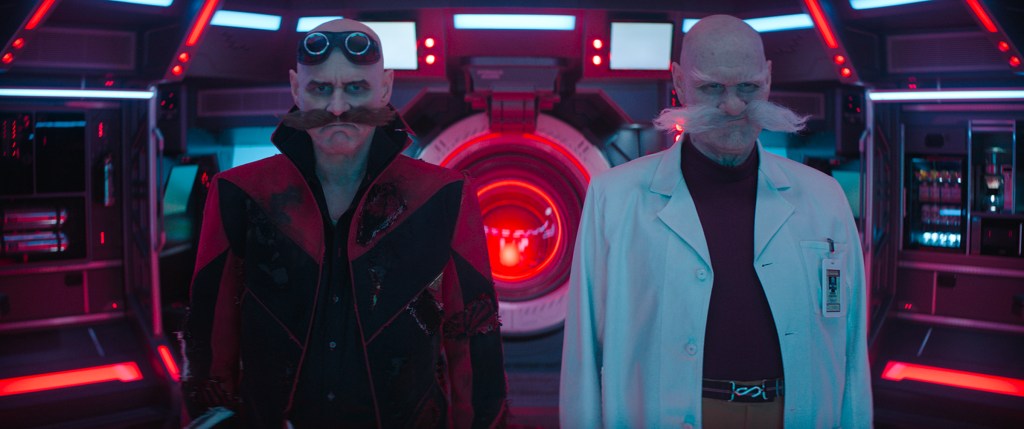
Speaking of fun, Jim Carrey is the standout here, playing two characters this time around: Dr Ivo Robotnik and his grandfather, Gerald Robotnik. Carrey steals every scene he’s in and is at the top of his game as he brings his whole overzealous being into the performances, using every trick in his book of physical humour to give these characters their own special place in the Carrey-verse of whacky weirdos. Whether it’s the whimsical banter and affection Ivo shows Gerald, the grouchy, bad-Santa esque vibe that Gerald exudes, or simply the floor crawls and random dance breakouts — Carrey is clearly having a ball and is reason enough to see the film.

Jim Carrey as Ivo Robotnik and Gerald Robotnik in Sonic the Hedgehog 3 from Paramount Pictures and Sega of America, Inc.

There are other returning faces as well, namely in the form of Tom (James Marsden) and Maddie (Tika Sumpter), but like the humans in the latest spate of MonsterVerse films, they’ve really become more like a distraction rather than an addition to proceedings. Fowler uses Tom as an emotional bridge between Shadow and Sonic, to show they’re both fighting for the same thing (those they love, or the memory of those they love), but the film is at its boisterous best when it focuses on the fun and games.

For a trilogy of films that started off on the wrong foot with that atrocious initial Sonic design, to see just how well it’s recovered and continues to be received is a testament to the heart that Fowler and the rest of the cast and crew have poured into the franchise. Whether you take a liking to the Sonic universe or are just looking for something to see over the holiday season, Sonic 3 is the perfect family film with enough humour to not feel overbearing and enough action to keep you on the edge of your seat.

Sonic the Hedgehog 3 spins into cinemas from Boxing Day.

Mufasa: The Lion King is a Serviceable Origin Story

Rating: 3 out of 5.

Mufasa: The Lion King preview screening provided by Disney

When word first came that Barry Jenkins’ next project after his hit mini-series The Underground Railroad (2021) would be an origin story about Mufasa from The Lion King (1994), it’s safe to say that there were some brief head-scratch moments. After all, Jenkins hasn’t really had a miss in his filmography and there are always doubts when it comes to beloved IP taking similar or new directions. Mufasa: The Lion King (2024) is no Moonlight (2016), but it does offer a new light on one of Disney’s most celebrated animated characters, bringing his story (even if James Earl Jones’ iconic voice is no longer with us), to life on the big-screen.

From early on, it’s safe to say that Jenkins didn’t really have too much leg room to stretch out to, with the world of Mufasa being rooted in the Pride Lands of Africa. In that sense, his options were clearly limited in terms of scope and the type of origin story he could tell about a lion rising up through the ranks. In this way, Mufasa takes a bite out of The Lion King‘s notebook by focusing on a tragic event in the form of a flood (told through a flashback sequence by John Kani’s mandrill, Rafiki) that would shape cub Mufasa and inform his life thereafter.

In the same way that his son Simba (Donald Glover) would be forced to reconcile with his situation of loss, Mufasa (Braelyn Rankins, later Aaron Pierre), too, is adopted, not by a warthog or meerkat but by a new pride some distance away from his old one. Key to his success in being accepted in that pride are Taka (Theo Somolu, later Kelvin Harrison Jr.) and his mother Eshe (Thandiwe Newton), much to the disdain of their father and husband Obasi (Lennie James), respectively.

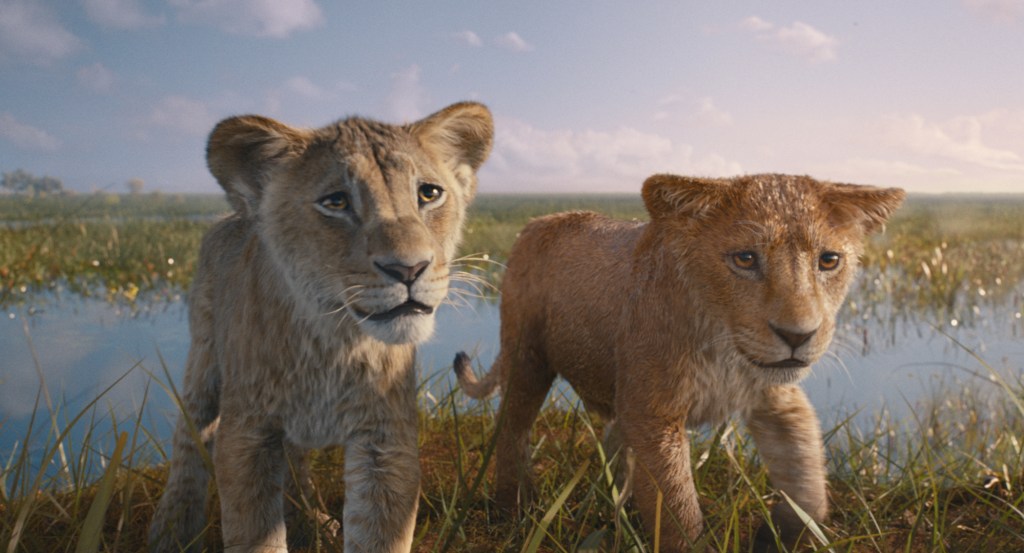
(L-R): Taka (voiced by Theo Somolu) and Mufasa (voiced by Braelyn Rankins) in Disney’s live-action MUFASA: THE LION KING.

What ultimately tests these lions’ ability to act as a cohesive pride is a competing white pride of lions, led by Kiros (Mads Mikkelsen). It doesn’t take long for Taka and Mufasa to find themselves on the run, though, as they seek out Milele — a land deemed a fantasy. This journey between the step lions is where Jenkins aims to mine the emotional core of the film, testing the strength of their relationship by throwing in a love triangle with a lioness, Sarabi (Tiffany Boone), and really looking to flesh out what it means to be a “king”, whether it’s a birth right or something to be fought for and earned.

This brotherly tussle is what really holds the film together during moments where it threatens to nosedive, especially in the late second act as it brings in twists and starts to lay the groundwork for motives in The Lion King. The biggest hurdle, however, in a film about life-like lions who talk and sing, is building that connection to these characters, a shortcoming that marred Jon Favreau’s 2019 remake. As far as the technology has come since Favreau’s film, photorealistic lions just don’t have the same expressiveness as animated ones, especially when you consider the 1994 animation has aged gracefully while the 2019 remake hasn’t, and it’s only been five years.

Lin Manuel Miranda also seemingly swapped Moana 2 (2024) for Mufasa, with songs that are identifiable to him but similarly to Moana 2, fall short in creating memorable moments that will stick in your mind.

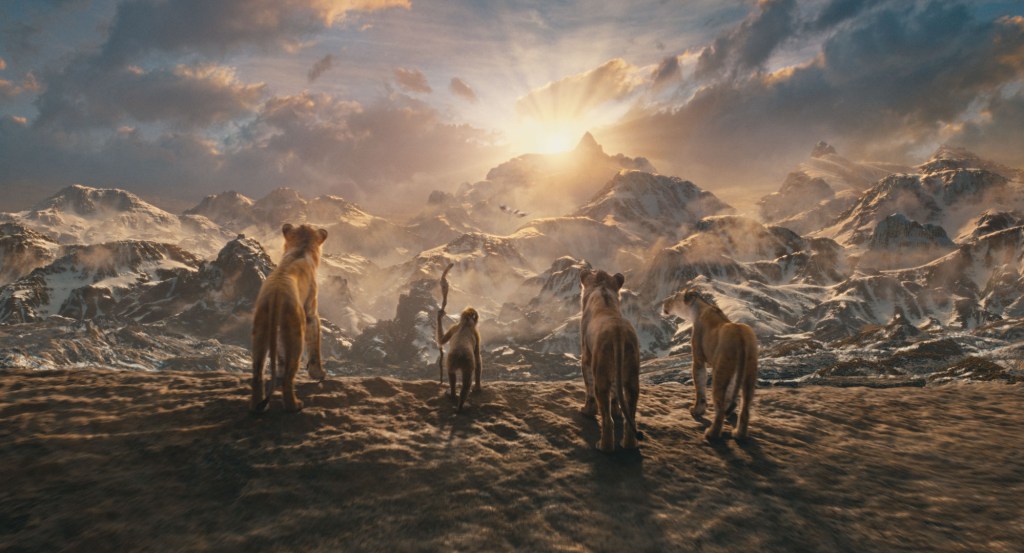
(L-R) Mufasa (voiced by Aaron Pierre), Young Rafiki (Kagiso Lediga), Taka (voiced by Kelvin Harrison Jr.) and Sarabi (Tiffany Boone).

The added element of having Rafiki do a retelling can also feel jarring at times, especially as it pulls you out of the story he’s trying to recite which interrupts the flow and pace. Most of us know what happens to Mufasa and who Taka eventually becomes, so that’s the least surprising thing about this film, but keeping us anchored to their journey and to the vistas of the Pridelands would have saved the filler scenes from being exactly that.

The Lion King‘s idea of the circle of life is about finding balance and harmony, something Jenkins’ film takes and glosses over in a similar light by creating a state of imbalance and power struggles that have to be overcome. In fact, most of Mufasa is a gloss over, sometimes for better (the visuals are still more refined than its live-action predecessor) and sometimes for worse (the retreading of old ground amidst the new ground covered, a shortcoming Moana 2 also suffers from). As a prequel, Mufasa makes sense (even if Jenkins’ involvement is bemusing) and it gives a welcome insight into one of Disney’s most beloved characters, coming full circle in the process.

Mufasa: The Lion King opens nationally from the the 19th of December.

Moana 2 is as Endearing as the Original but Suffers from Sea-quel Sickness

Rating: 2.5 out of 5.

Moana 2 preview screening provided by Disney

Upon rewatching Moana (2016) the other night, I was reminded just how special a place that film occupies in Disney’s catalogue of releases: it both captures and celebrates Polynesian culture so sincerely while at the same time offering a fresh spin on Disney’s heroine-oriented stories by avoiding becoming another princess film with tropes we’ve seen countless times over. Moana 2 is fine, but I found myself scratching my head throughout, not because I felt like there wasn’t an interesting adventure to be had, but because this adventure feels like it has been had.

After a thick-of-the-action opening where we find Moana (Auli’i Cravalho) scouring a cliff face in search of signs of other tribes and people, it doesn’t take long for the sea to once again call Disney’s beloved Polynesian not-princess, to its aid. There are no Lin-Manuel Miranda tunes to propel her forward this time around, with the Hamilton creator opting not to return for a second stint, but rather a vision from an ancestor that shows a new destiny — to seek out a lost island that would connect all the peoples from the near beyond.

To do so, she will have to overcome an ancient god, Nalo (Tofiga Fepulea’i), who has put a curse on the island, but first she has to find it. Of course, it wouldn’t be an adventure without her trustee demigod buddy Maui (Dwayne Johnson), who has found himself entangled in his own mess and needs saving. The duo will see themselves accompanied by old and new crew members alike, like the single brain-cell chicken and her porky friend.

Still from Moana 2

As sequels tend to go, bigger always seems to be the preferred option, otherwise you’re just treading old ground, right? While going bigger is what Moana 2 naturally has to do, what makes the first film so special is that it is an intimate film of self-discovery, of venturing into the unknown and realising your destiny. In expanding the second film, both in terms of characters and action on the screen, Dana Ledoux Miller, Jason Hand and David Derrick Jr.’s film sacrifices intimacy for a more generic storytelling approach.

That’s not to say that Moana 2 isn’t filled with thrills and spills: there’s a wider array of monsters, the set pieces are more rampant, the animations are the highlight as always, and there’s just more happening on the screen. Moana has also embraced the wayfinder lifestyle and doesn’t hesitate to seek out adventure, so there has been deeper character development on that level. It makes sense from a storytelling point of view to throw her into the deep end and have more to do and overcome. However, I couldn’t help but feel that that’s not what this story needed, especially when the first film was such a perfect standalone that at once pulled at your heartstrings but would also throw in a Jermaine Clement crab curveball every now and then to keep you on your toes and smiling where it counts.

The biggest fault in a film about going bigger and louder is that it’s often looking back to do so. Most of the humour banks on similar punchlines to the first film like constant cutaways to the chicken either picking at something or screaming, while the songs themselves by Abigail Barlow and Emily Bear don’t have the same flair or catchiness to Miranda’s, even though they’re very much striving to land in the same way. Kakamoras (those cute little coconut people) once again make an appearance, and it’s one of the better highlights of the film as they team up with Moana and co to take down a large clam-shaped mountain. In trying to offer something new, the directors have looked back in large part, and when they have offered something new, it hasn’t left a lasting impression.

Maui (Dwayne Johnson) in Moana 2

One such new offering is the villains (if we can call them that) with Nalo, and to a lesser degree Sina (Nicole Scherzinger). They’re two characters who serve less as villains and more as obstacles to overcome, and they’re offered little development and motive, with Nalo in particular whose whole shtick is he hates Maui and humans and wants to keep the island of Motufetu away from their grasp.

Moana 2, like most of Disney’s films, is a children’s movie first, one with adult themes that cater to audiences young and old, second. The child in me was having a ball for the most part, but also trying to find something to cling onto beyond the fun and games (or that second part), and that’s been my general sentiment towards some of these films in recent times. With the cliffhanger the film ends on (make sure to stay for the post-credits scene!) the second film always felt like a shoehorn for more to come, especially with a live-action remake of the original in the works. While I’m always dubious about such directions, the Moana IP is still rife with joy and potential, and it’s always a pleasure to see Polynesian culture still continue to be represented and resonate with audiences.

Moana 2 opens nationally from the 28th of November.

Gladiator II Continues the Original Story with Bigger, Wilder Action

Rating: 3.5 out of 5.

Gladiator II preview screening provided by Paramount Pictures

Some might say that retracing your steps is a copout, a way of looking back rather than forward. It’s why a film like Blade Runner 2049 (2017) is just as revered as the original, because it went with a new direction courtesy of Denis Villeneuve while remaining faithful to the ethos of the original film. But in the same way that JJ Abrams treaded old ground while elevating the look and feel of an iconic IP with Star Wars: The Force Awakens (2015), so too does Ridley Scott in Gladiator II (2024), his sequel to his critically acclaimed Gladiator (2000).

Gladiator stood out for many reasons, not least because it won Russell Crowe a rightful acting Oscar, but it also represented the merging of the old with the new, practicality with increased digitisation. It paved the way for films like Peter Jackson’s The Lord of the Rings trilogy and Gore Verbinski’s Pirates of the Caribbean trilogy, films that we now look back on with reverence because of how they combined scale (in setting, in action etc.) with those close, intimate moments of characterisation and the human condition.

Gladiator II doesn’t stray too far from the path of the original film, going so far as to retain the meagre visual effects, but it speaks to an era of filmmaking that caught audiences by surprise for all the right reasons.

Scott once again transports audiences back in time to arena battles, slave trading and overly pompous rulers. There’s no Maximus anymore but his presence is still felt. It’s Lucius (Paul Mescal), however, who, after attempting to defend his home in Numidia before it’s besieged by Roman battle ships, finds himself back in Rome as a captive years after fleeing from those who would have seen him killed.

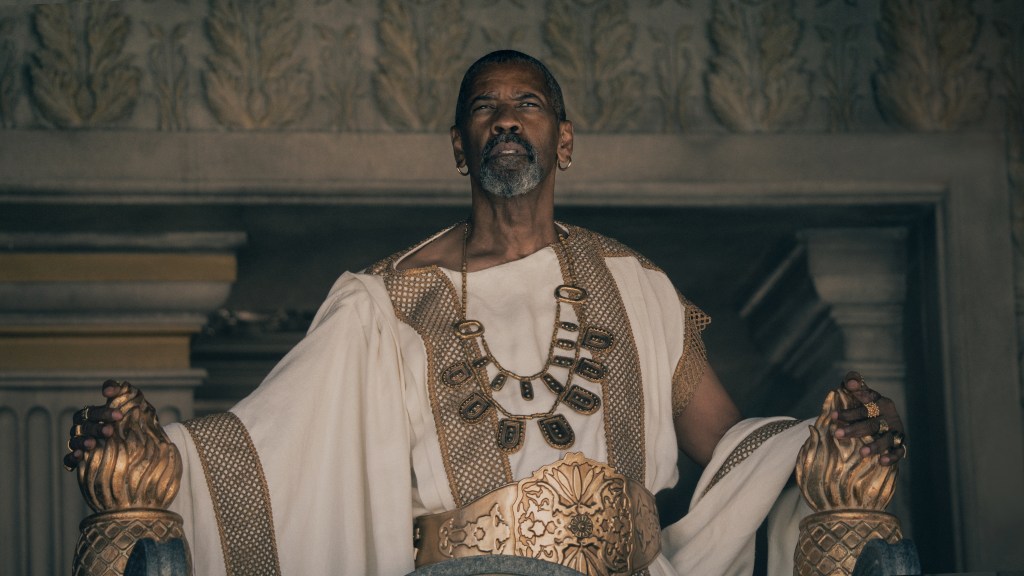
Denzel Washington as Macrinus in Gladiator II.


Lucius, like Crowe’s Maximus but via different circumstances, is forced to reconcile with his destiny to restore order back to a Rome that’s being ruled by two incompetent emperors. It takes some time to get to that point though as he’s put through his paces in a brutal bout with enraged CGI baboons, impressing a slave trader in Macrinus (Denzel Washington) who buys him for his prospects in the gladiator arena.

If that all sounds familiar it’s because Scott has repurposed the plot of the original film and doubled down on everything from flashier set pieces to a wider array of production elements and even more CGI. There’s a great deal of fan service in this film in the same way that the aforementioned The Force Awakens or even Alien: Romulus (2024) cater to returning audiences.

There’s nothing inherently wrong with this approach, especially when an actor like Washington revels in his snakey, almost Baelish-Game-of-Thrones-esque approach to proceedings while delivering lines like Robert McCall if he lived hundreds of years ago (“gimme the bow”) — you just can’t quite read him. Even more than that, this genre of filmmaking is Scott’s bread and butter to the point where, regardless of its historical inaccuracies (sharks in the Colosseum anyone?), it never feels like he’s trying to outdo his past film, but give you more of the same.

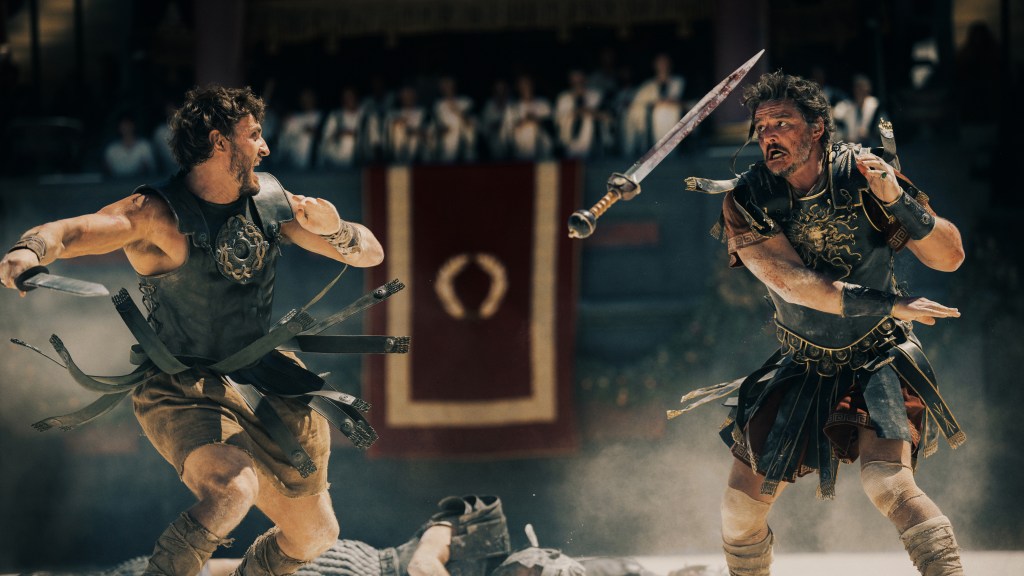
Paul Mescal as Lucius and Pedro Pascal as Marcus Acacius in Gladiator II.


The biggest fault in a film about a man who’s lost it all and is coming back from the brink is that you need to be able to buy into his cause and feel his emptiness. While Mescal has cashed in some really soul-tugging performances like in Aftersun (2022) or All of Us Strangers (2023) he doesn’t command the screen with the same gravitas that Crowe did. It helped that in the original, Joaquin Phoenix delivered just as compelling a performance as Commodus and was given ample screen time to have you loathe him just as much as Maximus did.

This time around, you have whiny emperors, a slowly unraveling Macrinus, and a misunderstood General in Marcus Acacius (Pedro Pascal). In this way, Lucius’ battle is spread across characters who are also in one way or another, battling each other. As a result, the stakes don’t feel nearly as big as the scale of the rest of the film, as great as it is to see these various storylines and plot lines interconnect and clash.

There’s a lot going on this time around whereas the screenwriters of the original, (David Franzoni, John Logan, and William Nicholson) spent more time exploring who Maximus was and giving him that more refined arc that makes him so iconic to this day. The same can’t be said for David Scarpa’s script as it does lack the deeper exploration of character needed to get you that aforementioned buy-in. This is a Ridley Scott film, however, and what’s never lacking is a memorable time or several key memorable moments; it’s all the same at the end of the day, so there’s no need for another rhetorical “are you not entertained”, it’s enough for Scott to leave you entertained.

Gladiator II opens nationally from the 14th of November.

Saturday Night Attempts to Relive the Night SNL Launched

Rating: 2 out of 5.

Saturday Night preview screening provided by Sony Pictures

The 90 minutes in the lead up to what is now a staple of American television culture in Saturday Night Live (SNL), was a chaotic, frantic race to deliver the goods. As anyone who has previous worked in a live television studio would know (whether seriously or recreationally), getting everything and everyone in one place at one time without missing a beat isn’t for the faint hearted, let alone when hot headed producers are breathing down your neck, hoping you slip up so they can show re-runs of Johnny Carson.

That was the case, at least, for the folks behind Saturday Night, something that Jason Reitman (known for 2007’s Juno and being the son of Ivan Reitman) tries to capture in his 110 minute feature of the same name. It’s an audacious task to say the least: how do you condense 90 minutes into a feature that tries to stick to time in the same way? The answer is, you don’t, but the intensity and scrambling is felt with every cutaway to a timer tracking the minutes.

And Reitman tries to make every minute count in the same way Lorne Michaels did that very night. The lead up to going live is a mess, something that Reitman shows by building tension through multiple tracking shots and long takes that portray the various moving parts as they interject and get in each others way.

At the centre of it all is Michaels (Gabriel LaBelle) who is trying to wrangle everything while convincing TV exec David Tebet (Willem Dafoe) that all is under control. Of course, it isn’t, with contracts left dangling, pieces of the set falling apart, various egos clashing —Chevy Chase (an uncanny Cory Michael Smith) and John Belushi (Matt Wood)— and drugs being snorted. There’s a verisimilitude to the portrayal of disarray, not least because historical accounts by those involved tell a similar story.

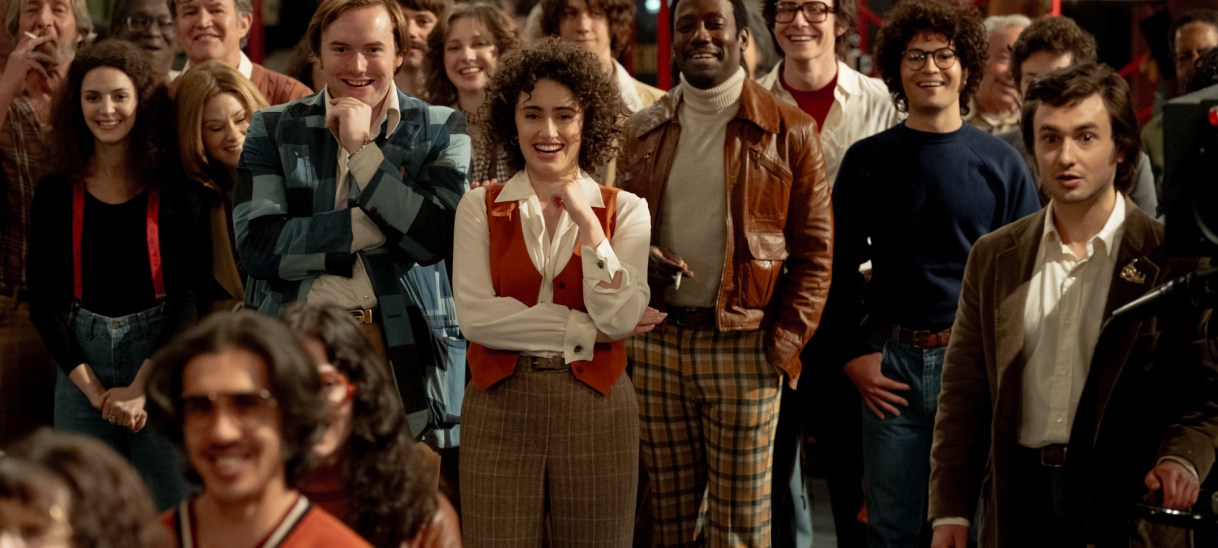
Lorne Michaels (Gabriel LaBelle), Jacqueline Carlin (Kaia Gerber), Chevy Chase (Cory Michael Smith) in SATURDAY NIGHT.

There’s clearly a great admiration from Reitman towards SNL, both in the haphazardness of proceedings, the wittiness he injects into character back-and-forths, and the sense of building towards something special. Yet for all Reitman’s attempts to relive the night and build up to showtime, the film feels like a checkbox exercise for actors to do impressions of your favourite 70s comedians — with jokes that you’ll get tired of in no time.

But perhaps the biggest drawback in a film about people trying to make it is the knowing that they will make it. As a result, you’re clinging to thin character threads for 110 minutes based on real people; it almost turns a film about a process into one of the bits that Michaels pulls down from the pin board because it just doesn’t quite fit.

While a tad over-dramatised for its own good, and over-reliant on throwing out average lookalikes to the original cast for a cheesy one-liner every now and then, for people like myself who aren’t SNL diehards or who weren’t aware of the backstory behind the tumultuous opening night show, Reitman’s film provides a welcome insight into something that has continued to persist to this day, even if it’s past its golden days.

Saturday Night opens nationally from the 31st of October.

Joker: Folie à Deux Treads Familiar Territory to its Predecessor

Rating: 2 out of 5.

Joker: Folie à Deux preview screening provided by Universal Pictures.

When word came out that Todd Phillips’ sequel to his box office hit, Joker (2019), would take the form of a quasi-musical for large parts, intrigue with a sprinkle of hesitation was coursing through the veins of pop culture discourse. After all, Phillips’ track record with sequels, namely the Hangover sequels, isn’t exactly the most compelling; but when you’ve got Joaquin Phoenix helming your film, anything is possible.

It wasn’t until news of Lady Gaga’s involvement with the sequel, however, that interest really started picking up. Here’s a director who’s landed arguably the greatest actor of his generation for a second roll of the dice, AND he’s got one of the biggest pop stars in the world as well? Well, If A Star is Born (2018) was a recipe for success, Joker: Folie à Deux was practically a delicious dish waiting to be served.

And to be fair, that intrigue carries into the first 20 or so minutes of Folie à Deux, with the events of the first film where Arthur Fleck (Joaquin Phoenix) blew out the brains of a hit late-night talk-show host live on TV, permeating. Arthur is now a martyr of sorts to other troubled minds, with a TV movie charting his killings earning him far reaching recognition, however he’s also in Arkham Asylum and hardly reaping the benefits of his infamous status.

It’s in these first 20 minutes that Phillips also sets the stage for Arthur’s eventual relationship with Harleen ‘Lee’ Quintal (Lady Gaga), an arsonist who catches Arthur’s eye from within the prison’s singing group for inmates. After Arthur is enrolled in the class by a brutal prison guard (played by the legendary Brendan Gleeson), it’s easy to see where this thread is going.

Whether or not Lee is drawn to the real Arthur or his alter-ego Joker, is still relatively vague at this stage, but it’s a concern that Phillips leans on for a majority of the film’s tension — the distortion between reality and fantasy. The idea of unpacking where Arthur Fleck ends and where the Joker begins is an interesting one, if it wasn’t already so fleshed out in the first film.

(L to r) JOAQUIN PHOENIX as Arthur Fleck and LADY GAGA as Lee Quinzel in Warner Bros. Pictures’ “JOKER: FOLIE À DEUX,” a Warner Bros. Pictures release.

It’s also what the film’s many jazzy musical numbers serve to emphasise, as they speak to Arthur’s attempt to cope with and manage the reality he’s been dealt and the fantasy he’s created for himself. Oftentimes I found myself at odds with these numbers, where at once they offer little glimpses into the psyche of a self-absorbed psychopath, but also act as distracting detours that seem to be the only opportunity to give Gaga some leg room to do… well… anything (though I’m mindful this is a film about the titular character and not the Harley Quinn show).

These numbers become even more prevalent as the film kicks into the second act where Arthur is on trial for his murders, as the jury seeks to determine whether he’s downright insane, or playing things up for show — essentially the film’s primary concern. This whole courtroom drama, second act overstays its welcome, with drawn out nothingness that reminded me of just how well other film’s manage similar situations (like 2023’s Killers of the Flower Moon). Phoenix gets some brief moments to lean into his even thinner physique, but beyond that this whole middle section feels like its treading old ground that the first film already established and resolved.

The brilliance of the Joker character in the DC universe has tended to shine through his caped crusader counterpart. It’s why Nolan’s version of Joker is so memorable, because he feels like a larger than life presence — something that’s earned in those films through methodical world building. In Folie à Deux, Arthur is contending with himself for a large majority of the film, trying to redeem himself in parts while succumbing to the voices within, in others. For such a big film, in this way it feels rather small which comes at the expense of the sort of substance you might expect from a film about such a recognisable character. As a result, a lot is banking on Phoenix’s performance to carry the often dull moments, but the shock factor of seeing him embody the character in the same way he did in the first film flies out the window this time around, so the shortcomings in the script are more noticeable.

While reducing the scale and confining audiences to Arthur’s world is a welcome subversion to what audiences might expect, it comes at the cost of an entertaining narrative. There are no mind blowing set pieces or scenes that build momentum into something; the biggest moment of the film comes rather late on, and even then it closes itself up faster than it opened (which will make sense as you watch the movie). Arthur —and by extension, the Joker— is relegated to the sidelines: he poses no palpable threat in the same way he did in the first film, and as a result the stakes don’t feel nearly as significant because he’s contained. Whether or not that’s a satiating enough angle for audiences by the time the credits roll is hard to say, but you may be left hungry for more.

Joker: Folie à Deux opens nationally from today.

Beetlejuice Beetlejuice: Tim Burton Turns Back the Clock with a Nostalgic Sequel

Rating: 4 out of 5.

Beetlejuice Beetlejuice preview screening provided by Universal Pictures.

Whether you like him or not, mesh with his unique aesthetic or run the other way, Tim Burton occupies a space in modern cinema that he’s carved from consistency: in strangeness, in the casting of brilliant oddballs, and in retaining his trusted collaborators. It’s a big reason why Beetlejuice Beetlejuice (2024), his follow-up to the now classic Beetlejuice (1988), is such a breezy experience at the cinema, one that picks up effortlessly from where its predecessor left off, and feels just as fresh and alive as it did 36 years ago.

It’s all the better, in fact, with this sequel using the foundations established in the first film and elevating them to a level of zaniness and tomfoolery that only Burton is capable of. Beetlejuice Beetlejuice plays out like a celebration of its predecessor, one that’s well thought out and that doesn’t feel like it’s had to reinvent itself for a modern audience. That’s in stark contrast to Burton’s attempt at Dumbo (2019), a film that from the outside looked like it was marred by too much intervention and creative oversight by Disney to the point where it felt like two visions clashing, with the result being a pretty mess.

Burton’s return to his own fabled creation has the opposite effect, showing a director who’s at ease and in his element, as though he needed a reset by returning to something so beloved to find his groove again. The title sequence attests to this, with a sweeping overhead shot of the town of Winter River that’s almost identical to the one he utilised in the first film; it’s a familiar, nostalgic sight, with most of the film leaning on callbacks to the original to appeal to audiences both old and new.

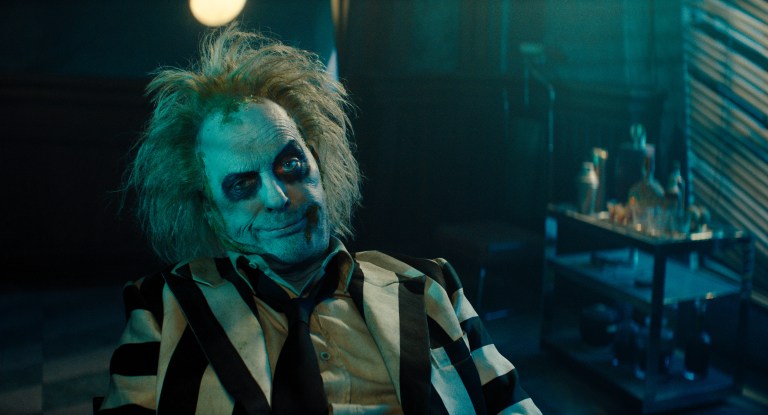
(L-r) WINONA RYDER as Lydia and MICHAEL KEATON as Beetlejuice in Warner Bros. Pictures’ comedy, “BEETLEJUICE BEETLEJUICE.”

From the overhead shot, we land on Winona Ryder’s Lydia Deetz who’s now hosting her own show on paranormal horrors as though this was an episode of Ghost Hunters. She’s still just as quirky as in the first film, but is also much more on edge as she’s clearly still haunted by her own encounter with Beetlejuice (Michael Keaton) many years ago. It could also be that her overly sleazy TV-producer boyfriend, Rory (Justin Theroux) is right up in her business trying to solve her problems the moment she gets a bit jittery; or even that her own daughter Astrid (Jenna Ortega) ignores her texts and doesn’t believe her ghost obsessions.

The truth is, it’s a mix of those things, but especially the former. Beetlejuice’s presence is still felt by the characters of the first film, including Delia (an ever so comical and hilariously bougie Catherine O’Hara), but he’ll play a key part in helping them deal with the film’s wider threats, including an old flame of his, Delores (aptly played by Monica Bellucci), who’s stapled herself back from the dead and wants revenge.

That’s not the least of the backstory that Burton traces through, with the first 25 or so minutes of the film introducing and reintroducing the film’s characters. Others include Wolf Jackson (Willem Dafoe), a dead-actor-turned-detective in the Afterlife who’s full of wits as he’s tasked with tracking down Delores, treating his job like a performance in the process. The standout of the newcomers is of course Ortega who, after her success with Burton’s hit Netflix show Wednesday, slots effortlessly into the director’s zanny world. Her chemistry with Ryder is a revelation, with their pairing singing the tune of the film and its theme around reconciliation and the bond between a mother and daughter.

(L-r) JENNA ORTEGA as Astrid and WINONA RYDER as Lydia in Warner Bros. Pictures’ comedy, “BEETLEJUICE BEETLEJUICE.”

The Afterlife itself is just as teeming with (dead) life, and looks just as vibrant and charming as it did all those years ago. It’s a testament to production designer Mark Scruton’s eye for detail as he decorates this setting with even more personality and character through his whacky designs. In fact, all of Burton’s collaborators are on their A-game, especially his regulars; Danny Eflman’s score has an ethereal quality that is reminiscent of the heyday of this genre of film, while costume designer Colleen Atwood once again dresses the cast to impress, to the point where one’s eye is naturally drawn to all characters lurking in the background.

There’s rarely ever any wasted space in a Burton film which is something that all filmmakers working in tight runtimes should aspire to. Every frame feels well thought out, every gag is executed cleanly and every prop feels like it’s just where it needs to be. Keaton has more screen time this time around as well, but everyone gets a share of the spotlight. There’s even time for a Chucky-esque demon baby-Beetlejuice, a room full of awkward Bob-like, small-headed, big-bodied beings, and a ‘Soul Train’ that —befitting to its name— transports soul musicians (and has wider implications in the plot). It’s a film that feels like it was made for the 80s gothic B-movie scene, was somehow never shown the light of day, but was unearthed at the right time.

Beetlejuice Beetlejuice opens nationally from the 5th of September.

Blink Twice and you Might Miss the Thrills and Spills of Zoë Kravitz’s Debut Feature

Rating: 3.5 out of 5.

Blink Twice preview screening provided by Universal Pictures.

It’s 2024 and movie characters in thrillers are none the wiser, still choosing to vacation with strangers on secluded islands in the middle of nowhere. That idea has tickled the fancy of first time director Zoë Kravitz whose star studded feature Blink Twice, which she co-wrote with E.T. Feigenbaum, is ripe with dark humour, bubbling tension, and is gripping from start to finish.

As it turns out, Instagram doesn’t tell you about stranger danger, at least not to Frida (Naomi Ackie). She’s a barely-getting-by waitress who we meet as she’s scrolling through the social media app before finding herself enthralled by millionaire Slater King (Channing Tatum) in a strange apology video he’s issued. Whether for better or worse (which becomes clear as the pace picks up), she clumsily meets him while waitressing at a fundraising event with her friend Jess (Alia Shawkat), and when he asks her if she’d like to come to his private island, of course she says yes.

She’s not the only one who takes up his offer to ‘party it up’, as though this is one of Leonardo DiCaprio’s yacht getaways. King has decided to bring a whole group, one that’s comprised of celebrities like Sarah (Adria Arjona), his troupe of mates (Simon Rex, Haley Joel Osment, Levon Hawke, Liz Caribel, Trew Mullen, and Kyle MacLachlan), and a few other unsuspecting souls.

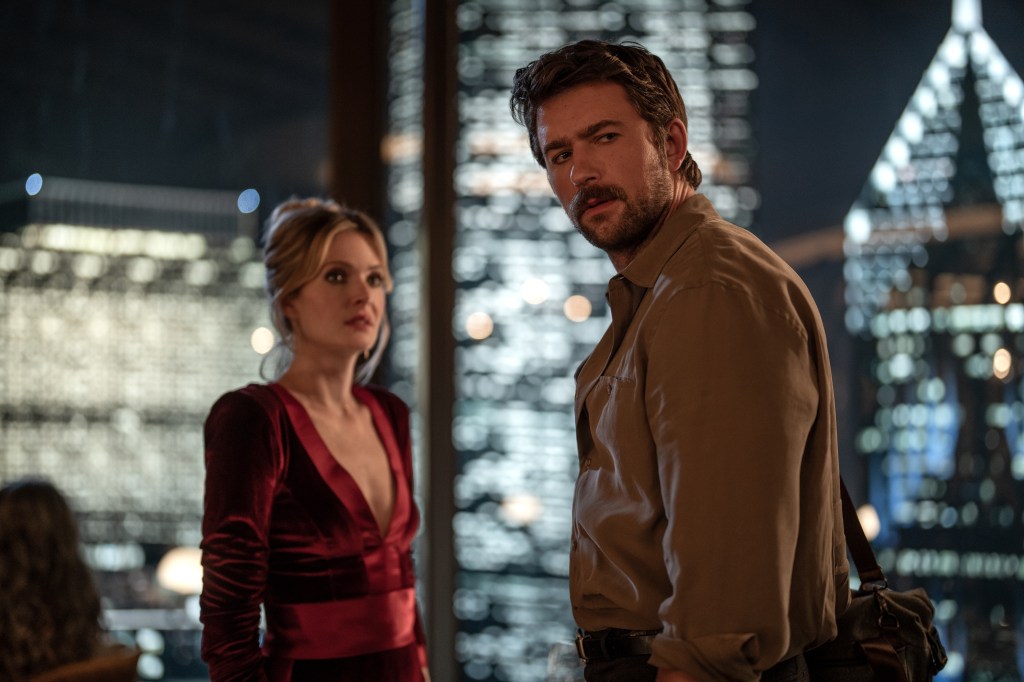
Channing Tatum stars as Slater King and Naomi Ackie as Frida in director Zoë Kravitz’s BLINK TWICE, an Amazon MGM Studios film.
Photo credit: Carlos Somonte
© 2024 Amazon Content Services LLC. All Rights Reserved.

The real fun and games commence on the island, which has a sprawling resort-like quality; frequently smiling, somewhat off-kilter staff; slithering snakes; and enough drugs to kill a herd of elephants. It’s hard to think one would ever want to leave when every day seems like a holiday, even if you don’t quite know what day it is and what happened yesterday —that’s all part of the deal, or so Frida tries to tell herself.

For what it’s worth, Ackie’s performance is solid, and when paired with Shawkat (and later, Arjona) she’s really able to lean into the constant state of flux that her character finds herself in. Coming off the back of his performance in Fly Me to the Moon (2024), Tatum is also able to hold his own, playing his rich, handsome but slightly-off/too-good-to-be-true character with a distant edge, proving that he can hold the weight of a tense scene with an equally tense gaze and charming quality.

Where similar debut thrillers like Don’t Worry Darling (2022) often have a promising start, they tend to struggle to bring plot points together in the final act and tailspin within their own twists and turns. In saying that, knowing that this is Kravitz’s debut feature is almost as wild as the film’s premise. Her direction is assured and distinct, and I was often reminded of Jordan Peele and his approach to his debut feature Get Out (2017), from which this film clearly takes inspiration from.

Kravitz’s style is especially evident in the groovy soundtrack and the frequently blunt, yet edgy, but altogether humorous, dialogue. Coupled with Kathryn J. Schubert’s snappy editing, which gives both a feeling of intoxication/trippiness as well as the flittering of time, the title Blink Twice reverberates deep into the film’s technical elements. It also helps that Kravitz is able to get all of her nuts and bolts into roughly 90-minutes where so many filmmakers today struggle to write compact scripts that don’t overstay their welcome. If Blink Twice is anything to go by, we’ll be talking about Zoë Kravitz a lot more in years to come.

Blink Twice opens nationally from the 22nd of August.

MIFF 2024: Powerful Performances Amplify the Trauma of Memory

Rating: 3.5 out of 5.

Screener provided as part of MIFF 2024

With heavy handed issues such as dementia and rape, films always run the risk of oversimplification and misrepresentation in less-than capable hands. Michel Franco’s Memory (2023) tackles these issues with a sincerity and empathy that doesn’t demote or reduce them, but rather examines them from the perspective of two struggling souls.

It’s through Sylvia (Jessica Chastain), a recovered alcoholic who was raped when she was 12, and Saul (Peter Sarsgaard), a widower with onset dementia, that Franco’s examination unfolds. If the situations of the two aforementioned characters are anything to go by, Memory is the sort of film that could very easily tailspin into, and be written off as, a grim and depressing sob story that treads old ground that similar films have already excelled at (like 2020’s The Father); fortunately, it does not.

The film’s tone is set from the outset, with Sylvia attending an AA meeting with her daughter, immediately establishing the sort of emotional roller-coaster that awaits. Clearly in a better place in her life now, Sylvia’s past deliberately remains unclear for most of the film (at least until a wider reveal in the third act) to ensure that enough tension remains throughout the modest 99-minute runtime.

Franco frames her as uneasy and on-edge, as she pedantically locks her apartment door, sets her alarms and assumes a guarded position when in uncomfortable situations, something that she extends to her daughter in an instinctively maternal, but overprotective, way.

It’s not until an evening at a high-school reunion, that the direction of Memory becomes clear. Sylvia is followed home by a man who casually approached and sat next to her, going so far as to sleep outside of her apartment in a tyre with nothing but a rubbish bag as a blanket. Saul is his name, and Sylvia quickly finds out that he’s not well.

It’s from here that Franco takes the duo and their past and current problems, and uses them as a catalyst for exploring how peoples situations and serious problems can so easily be reduced by those closest to them, that these people ultimately gravitate towards other troubled souls to find solace and understanding. And that approach is felt mainly because Chastain and Sarsgaard deliver profoundly moving and complex performances. The duo capture the trauma and pain their characters are going through in a way that elevates what, on paper, could have been a very basic thematic exercise that comfortably ticks the sort of boxes you’d expect from a film about grief.

Sarsgaard is subtle as Saul, giving enough from his performance to capture a man who is on the brink of losing his sense of self, while never losing the warmth he brings that draws you in; in this way, I was reminded a lot of Robin Williams’ Oscar-winning performance in 1997’s Good Will Hunting. Chastain is just as compelling, playing off of Sarsgaard effortlessly, and giving greater depth to Sylvia the more the two are on the screen together, slowly opening up as she builds trust for him after being asked to be his caretaker by his brother. It’s hard to take your eyes off of them, and if there is something that will stick with you beyond the end credits, it’s definitely the choices they make in bringing these characters to life.

Bubbling beneath the surface of the film’s central duo is a dysfunctional family thread that, while relevant in understanding the circumstances of Sylvia’s situation, does almost pop up at a wobbly moment. That said, it speaks to the idea that there never really is a great time to confront your past, especially when it’s as harrowing as Sylvia’s — it just presents itself in a tacked-on kind of fashion (especially when the film is at its strongest when it’s solely with Sylvia and Saul).

While the relationship that develops between Sylvia and Saul might not sit comfortably with everyone (given Saul’s growing dementia and need for specialist care), Memory asks its audience to see beyond circumstance and try to empathise with two damaged human beings who understand each other more than their own families do — something that its non-ending ending, invites.

Memory will be screening as part of MIFF 2024 in August.